Couple use music to treat autism, dyslexia, other disorders
By: JENNIFER KABBANY - Staff Writer | Sunday, November 30, 2003 6:13 PM PST ∞

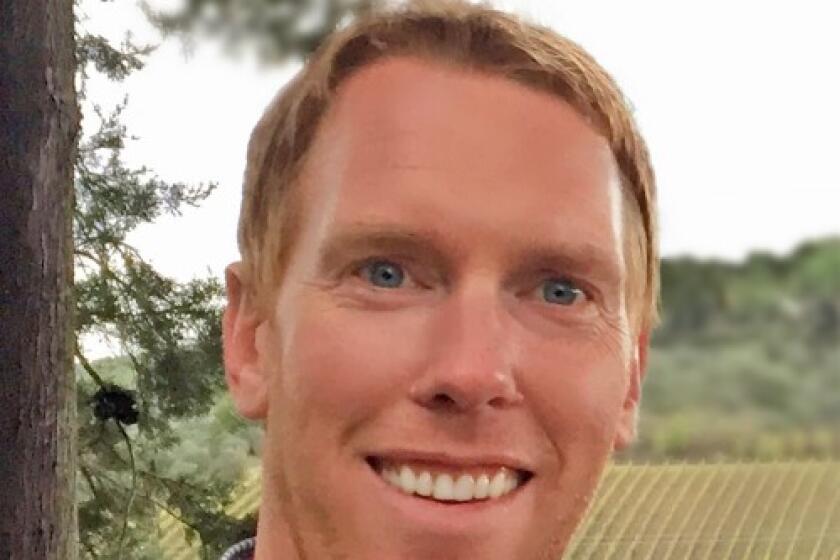
Karyne and William Meads hold the head phones, which is hooked up to specialized sound equipment, that children with disabilities wear while in the play area behind them at the SETI Institute in Vista on Wednesday.
Hayne Palmour
Order a copy of this photo
Visit our Photo Gallery
VISTA ---- At a 3-month-old facility in Vista's backcountry, two young patients ---- the center's only patients ---- play with puzzles and toys, draw colorful pictures, and sleep on fluffy couches while the sound of Mozart fills their ears.
Directors of the center, Sound Entrainment Therapies Institute, say they can cure children of autism, attention deficit disorder or dyslexia with a specialized testing process and a series of music-listening sessions.
The center's directors, the husband-wife team of William Meads and Karyne Richardson-Meads, say "sound therapy" is based on logic and science. But the medical community remains skeptical about the treatment's efficacy.
"As far as I know, there is no research to demonstrate the effectiveness of that treatment on autism or other disorders," said Doris Trauner, chief of pediatric neurology at UC San Diego. "There is not really any reason from a neuroscience standpoint to think that (sound therapy) would work."
A family affair
The Meadses are not doctors. Karyne Richardson-Meads has spent the past 26 years learning how to treat hyperactivity and other disorders by balancing the way the brain listens. A relatively new concept in America, it has been employed in Europe since the 1960s, she said.
"Our center has been healing hundreds of kids quietly for years and years," she said of the facility's Saint George, Utah, location.
The couple is in the process of moving to Vista to find new patients in Southern California. Karyne Richardson-Meads said many of their former patients came from San Diego. She believes there is a strong need for the treatment in the area.
Karyne Richardson-Meads, 53, says she earned a speech and pathology bachelor's degree from Brigham Young University, and a degree in ortho-molecular nutrition from the Colorado Springs, Colo.-based International Academy of Bioenergetic Practitioners. She says she also earned a "homeopathic degree" from the Poly Clinic Institute in Italy.
William Meads, 43, says he earned a master's degree in public administration and a juris doctorate from Brigham Young University. Both have children from previous marriages.
The two met when William Meads brought his teenage daughter in for treatment at the Utah clinic. His daughter's recovery was enough to convince him the treatments were effective. Falling in love was an unexpected bonus, he said.
The diagnosis
When a child showing symptoms of a learning disability comes to the center for an evaluation, the first thing Karyne Richardson-Meads does is to place bands around the forehead, fingers and ankles.
"There are no needles, nothing to prick, no blood," she said, adding that the sound therapy works on adults, but "kids heal faster."
The bands are part of a machine called the Quantum Spectra-Vision, which tests more than 9,000 substances in the body, including amino acids, hormones, enzymes and minerals.
The machine reduces all 9,000 pieces of information to a "frequency," at which point she does an analysis of the data.
"Interpretation of the results is complex, taking days or weeks to cross-reference the data," she said.
Once the analysis is done, she is able to determine what type of specialized music will help each child overcome his or her learning disability.
The music is set to violins, Mozart, fast tempos and high-frequency sounds, and played through $500 headphones that tap not only into the ears, but also the skull through a bone-conductor atop the headset.
The two-hour sessions are held two or three times a week for a few months, and usually cost from $2,000 to $7,000, depending on the complexity of the diagnosis, she said. Financing for single parents and low-income households is available.
How it works
Listening has long been linked to behavior, and sound is a nutrient for the brain, Karyne Richardson-Meads said. In order for the brain to function properly, it must listen properly, she said.
The term for the concept of synchronizing sound and brain functions is entrainment.
"Entrainment is harmony between movements and sounds, between the body and auditory," she said. "It's a prerequisite for the acquisition of language and for academic learning."
UCSD's Trauner said balancing the way the ears listen is not necessarily a prerequisite for learning in the case of autistic children.
"We know that children with hearing loss in one ear don't have these problems, (or) children who have brain damage to one side of the brain don't have this problem, so why do they think that autistic children are going to both have this problem and then benefit from something that might equalize (hearing) in both ears?" she said. "There is really no science in this ... no evidence."
Karyne Richardson-Meads said the need to listen with symmetry is that it reduces the back-and-forth between the left and right side of the brain.
The difference between listening and hearing is listening is an active event of focusing in, and entrainment helps children focus in on subject matter or what someone is saying, she said.
The music sessions teach the children how to listen properly, in effect evening out sounds and minimizing hypersensitivity.
The music's modality is specific to each patient.
"We use music as a tool to feed in the proper frequencies needed by each child," she said. "The ear takes sound waves and converts them to electric energy that charges the neocortex of the brain."
The way the brain formerly listened to sound ---- prompting or causing the learning disorder ---- is slowly transformed, correcting and healing itself, she said. The brain then remembers how to listen properly.
Ongoing debate
Karyne Richardson-Meads said the treatment works in conjunction with doctors' and pediatricians' advice and counsel, though the goal is to get children off of prescription drugs such as Ritalin. Sound therapy treats the heart of the problem, whereas prescription drugs treat the symptoms, she said.
The treatment is controversial. The Meadses concede that they have few patients in San Diego County, and the concept seems hard to swallow at first. However, they said they feel confident that use of the treatment will grow with time, and they point to new studies and books that support sound therapy.
Bernard Rimland, director of the San Diego-based Autism Research Institute, said his recent review of 28 studies on sound therapy show that some types of the treatment have a positive effect on children with learning disabilities.
"We just reviewed 28 such studies, and the results are really quite positive," Rimland said. "No one understands how the brain works. The fact that we don't understand why (sound therapy) works doesn't have a bearing on whether or not it does work."
For more information about the new Vista clinic, call (866) 738-4233 or www.setiadd.org.
Contact staff writer Jennifer Kabbany at (760) 631-6622 or jkabbany@nctimes.com.
11/30/03