Clean-water program costly to Encinitas

By: ADAM KAYE - Staff Writer | Saturday, January 24, 2004 11:18 PM PST

John King, a field utility maintance worker for the city of Encinitas, uses a hose from the vacuum truck to clean a gutter. King and his co-workers clean up to 18 storm sewers every day.
Michael J. Kacmarcik for The North County Times
Order a copy of this photo
Visit our Photo Gallery

ENCINITAS ---- Clean water comes with a price.

City officials have known as much for years, and last week introduced a plan that would have ratepayers cover about half the yearly cost of the $3.5 million Clean Water Management Program. City funds would pay for the remainder.

Federal and state authorities require local jurisdictions to reduce and purify runoff before it washes into oceans, lagoons and other waterways. The requirement comes with little or no financial backing.

"As far as unfunded mandates, this is the proverbial 800-pound gorilla," City Manager Kerry Miller said.

In spite of the demands Encinitas' clean-water program places on the city's general fund, the City Council last week balked at plans to tack a clean-water fee onto bimonthly trash bills.

The council sent the proposal back to its staff, with orders to rework it with accommodations for consumers such as nursery owners who already have invested money in runoff controls.

Some nursery owners say the fees ---- which are based upon water-meter size ---- present still another economic hardship.

Taxpayer advocates blasted the fee proposal, calling it a new tax that should face a public vote.

The debate over a clean-water fee, however, did not raise questions over the merits of the program itself.

Paying for the grime of the times

Encinitas pays big money to keep runoff free of contaminants: free of the oil, antifreeze and battery acid dripping from thousands of cars, the bacteria harbored in fecal material from pets and humans, the grease from restaurants, and all the other filth people produce just by being people.

The program's $3.5 million budget for 2004-05 has Encinitas spending $1.3 million for operations and $2.2 million for capital improvements.

Operating expenses include salaries and benefits for four, full-time employees, whose monitoring, reporting and enforcement actions are expected to cost $600,000; storm-drain maintenance and street sweeping are budgeted at $640,000; and flood-control costs are expected total $94,000.

Capital costs are expected to be $2.2 million a year for the next five years, and include the installation of new drainage basins and storm drains, and the purchase of equipment to manage runoff on streets, at parks and at public buildings.

Eddie Foy's salary is a portion of the operating budget. Five days a week, Foy begins his shift by grabbing a list of storm drains and sewer lines that require his attention.

Foy operates the 2000 Vac-Con, a powerful vacuum on wheels that flushes and cleans sewer and storm-drain lines. Wednesday he smiled after cleaning mud, pine needles and trash from a storm-drain inlet.

"Anything on God's Earth you'll find in these holes," Foy said.

Purchased in 2000 for $222,000, the Vac-Con is the flagship of the stormwater program. An 8-inch suction line rides on a boom and feeds a pump that can slurp 60 gallons of muck per minute into a 9-cubic-yard tank. The pump's motor wails like a jet engine, and the ground vibrates as it runs.

The Vac-Con also is fitted with a pressurized freshwater tank, hose and nozzles designed to flush Encinitas' 180-mile network of storm drains.

Another specialized rig is the city's camera truck, which shoots moving pictures of the insides of pipes. Since last year, crews have captured about 25 percent of the storm-drain network on tape. Officials expect to spend five more years to tape all of it.

Full of surprises

The pictures and field work reveal all kinds of surprises.

On Wednesday, utility worker John King found one treasure: a 1980-vintage cordless telephone. Other discoveries range from the unusual to the disgusting.

Foy said he could build an entire car with all the parts he has discovered. Once his crew alerted authorities after finding a dozen license plates in a storm drain near Scripps Memorial Hospital, Encinitas.

The license plates, plus other vehicle parts and debris, clogged the line and, in 2001, contributed to heavy flooding on Santa Fe Drive west of Interstate 5, officials said. No one knew where they were from.

Dead animals sometimes end up in storm drains.

Once, at the San Elijo Campground, campers emptied hot coals into a storm drain. The coals melted the walls of the 42-inch plastic pipe to 4 inches in diameter.

Workers have lifted storm-drain covers to find drivers have drained motor oil right through the grate. Unscrupulous motor-home owners have jettisoned the contents of their septic tanks into storm drains.

Foy discovered no such pollutants Wednesday while servicing a clean-out in Cardiff, which was spick-and-span after worker Silvino Matias washed it.

"Clean enough to eat off of!" Foy said, chuckling.

No thanks, said Kathy Weldon, Encinitas' stormwater manager, but the drain certainly looked better without all that muck.

"Otherwise that would have been on our beaches," Weldon said.

Launched by a lawsuit

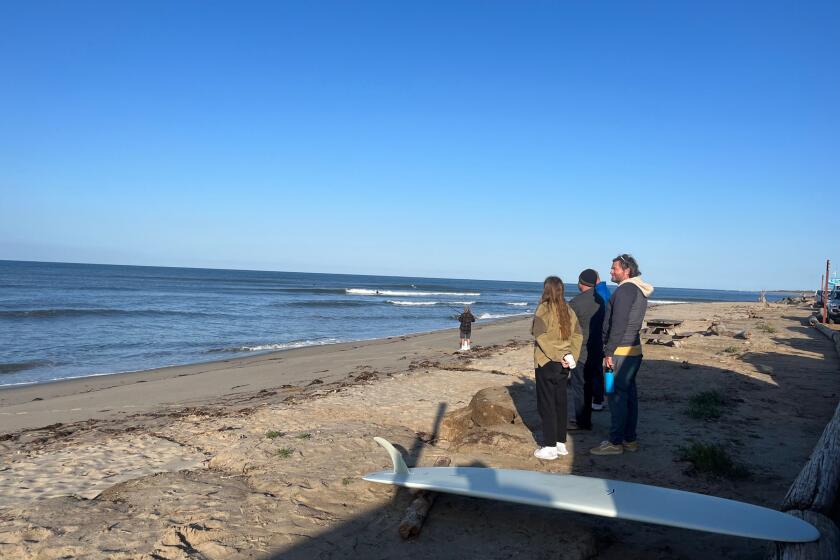
Much of the fuss over clean water began with Encinitas' 6.2 miles of beaches. In 1999, San Diego Baykeeper sued the city because it didn't have a clean-water plan.

Particularly maddening to Marco Gonzalez, a surfer and the organization's attorney, was the city's practice of pumping Leucadia floodwater right up and over the bluff without treating it.

Six weeks later, both sides settled out of court and soon were working together.

"The City Council we threatened to sue didn't want to be known as leaders of a dirty city," he said.

One provision of the settlement required Encinitas to install a drainage system in Leucadia, which it did in 2001 and 2002.

The $4.3 million Leucadia Boulevard Nuisance Water Collection System sends stormwater into a detention basin for treatment before releasing it into Batiquitos Lagoon. The problem, some residents and merchants say, is that flooding seems to have worsened since the system was installed.

On a happier note, Gonzalez said he helped city officials land the $834,000 state grant that paid for most of the $1 million treatment system at Moonlight Beach.

Installed in 2002, the system uses ultraviolet rays to kill bacteria in Cottonwood Creek just two blocks before the creek empties into the ocean.

If the number of contamination announcements are any indication, the system appears to be working.

In 2000, the county Department of Environmental Health reported unhealthy water at Encinitas' main beach 93 times.

In 2003, by contrast, officials posted contamination warnings only nine times. Those came mostly after heavy rainfalls, which require all river mouths to be posted.

By the numbers

City of Encinitas stormwater statistics, July 2002 through June 2003

Debris removed from storm drains, channels and wetlands: 603.5 tons

Debris removed by street sweeping: 120 tons

Bags of litter removed from channels and basins: 3,760

Sediment removed from channels and basins: 580 tons

Contact staff writer Adam Kaye at (760) 943-2312 or akaye@nctimes.com.

Next

Advertisement

Pre-Registration Comments[-]Go to Top
Registered Comments[-]Go to Top

Advertisement

Videos

Advertisement