Campo, Imperial airport costs detailed
By: MARK WALKER - Staff Writer | ∞
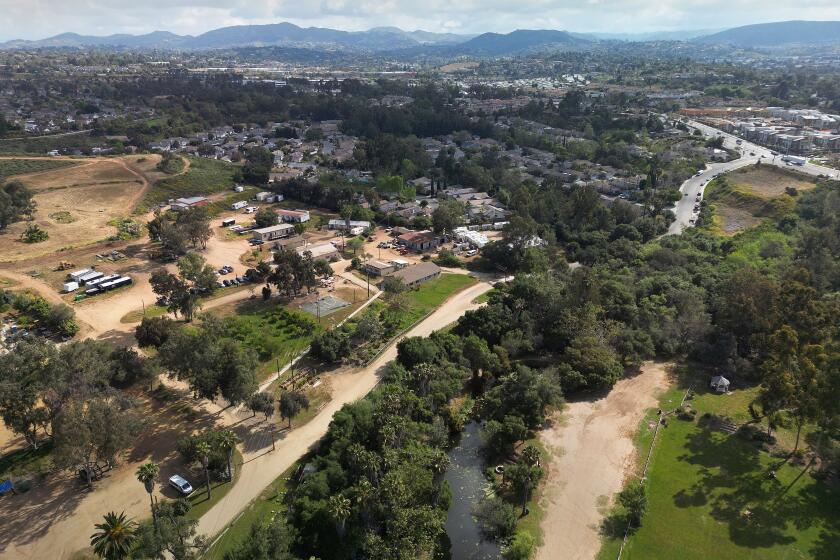
SAN DIEGO ---- Building an airport in Campo or Imperial County and providing utilities, a high-speed train link and improved roadways would cost about $17 billion if construction started today, according to cost estimates.
The San Diego County Regional Airport Authority heard the estimates Monday during a meeting of its strategic planning committee. It was the first time total costs have been given for any proposed new airport site.
Airport consultants Ricondo & Associates delivered the eye-popping figure for Imperial and Campo as the authority considers whether to expand the existing airport at Lindbergh Field or build a new one.
Costs for the Campo site in southeastern San Diego County came in at $16.9 billion, while the cost to build in Imperial County was put at $17.4 billion.
Imperial County officials contend, however, that that figure would be much lower if the proposed site was moved slightly to the east and away from land considered environmentally sensitive.
Actual airport construction was put at $6.4 billion for Campo and $4.1 billion for Imperial, where land is much cheaper.
Authority board member William Lynch said he worries any site that costs more than $6 billion would be difficult for the agency to pay for through airport revenues.
"We may never get more than half of the cost from any source other than the airlines," Lynch said in reference to the money the authority generates through airline leases.
Board member Paul Nieto said borrowing more than $2.5 billion would be difficult given the airport's current annual operating budget of about $100 million.
A new airport would be built primarily through airline and concessionaire lease revenues along with federal grants of an uncertain amount.
Vista Mayor Morris Vance, another of the authority's nine board members, said during a town hall meeting last week that he would oppose expansion of Lindbergh because there isn't enough room to meet long-term needs. Vance also said he was against Imperial because of its more than 90-minute drive for North County residents. He did not endorse any site or say where he would prefer a new airport be built.
The lion's share of the costs to build in Campo or Imperial are infrastructure costs for water, power, roadway improvements and high-speed rail to help passengers get to the far-flung locations. Those costs are put at $10.2 billion for Campo and $13.2 billion for Imperial.
Cost estimates to expand Lindbergh or build a new airport at one of three county military bases have not been compiled but would probably come in far lower, because road and utility improvements would not cost as much.
The airport authority has said it needs a roughly 3,000 acre, dual-runway airport to meet the expected 30 million to 35 million passengers forecast to fly in and out of San Diego by the year 2030.
Last year, Lindbergh more than 17 million airline passengers passed through Lindbergh.
Expanding Lindbergh would require the removal of numerous homes and businesses and would not alter the current restriction on overnight flights because of nearby residences.
A proposal for a "supplemental" air field in North County, a single-runway facility located on land sufficient to build another runway if needed, is also being examined by the authority's consultants.
They said Monday that such an airport at Rancho Guejito east of Escondido and north of Ramona won't work because of its proximity to nearby mountains and steep terrain in the immediately surrounding area.
But the search for such a site in North County is ongoing, and consultants are scheduled to bring back a report on possible locations on Feb. 13. They also will examine how such an airport could draw from Orange, Los Angeles, and Riverside counties.
On that same date, the authority also will get an update on the status of talks with the military, which has consistently said it needs all of its facilities and opposes sharing or giving up their land for a new airport.
Besides the three civilian sites, the other sites now under official consideration are three county military bases ---- Camp Pendleton, North Island Naval Air Station and Miramar Marine Corps Air Station.
Authority board member Robert Maxwell stressed as he has for weeks that the military brass needs to think about its needs well into the future.
"We're talking about 10 years from now and longer, not the current mission," said Maxwell, an Oceanside resident.
Board member Mary Sessom asked airport staffers to also revive a report on how removal of the Marine Corps Recruit Depot adjacent to Lindbergh would effect expansion on the current 661-acre airport.
One San Diego resident had one simple message for the authority on Monday ---- build a new airport at Miramar, the 24,000-acre base in the center of the county with easy freeway access.
"Do what is right," Tom Delahanty told the board. "We have to find a way to make Miramar work."
The airport authority, established by the state Legislature in 2003, is required to come with an airport plan this year. Its recommendation is set to go before county voters in November in the form of an advisory ballot. Obtaining all the necessary permits and then planning and constructing of a new airport would take an estimated 10 years or longer.
Much of the information presented Monday will be delivered again today during a meeting of business, government and military officials with a keen interest in the airport issue. That session takes place from 1-3 p.m. at the Hilton Harbor Island Hotel at 1960 Harbor Island Drive.
Contact staff writer Mark Walker at (760) 740-3529 or mlwalker@nctimes.com. To comment, go to nctimes.com.
On the Web: http://www.san.org
More Stories
Advertisement
Writer wrote on Jan 24, 2006 3:03 AM:Only $17 billion? Just add it on to Arnold's proposed California infastructure bond!
S wrote on Jan 24, 2006 6:37 AM:No way. I can't see the value of San Diego taxpayers at $17 billion dollars for a new airport next to Mexico. Even though they have been planning another field for sometime, we have been getting along just fine with one. This is a smokescreen and another example of beauracry spending money without thinking. If an aiport is placed done there, it won't grow San Diego...
Rodney wrote on Jan 28, 2006 11:20 PM:Ask anyone what’s the biggest problem in San Diego, and you’ll probably hear “traffic.” However, if we have learned anything in the last decade, it’s that we can’t build our way out of traffic congestion. Over the next 20 years, California is expected to add 15 million residents and more then 5 million households. San Diego, which is home to 2.6 million residents, has been steadily adding light rail track miles and transit rider-ship to its highly successful San Diego Trolley. It was one of the first new Light-rail systems in the United States opening in 1981 with a line from downtown to the Mexican border. San Diego’s civic leaders showed the leadership and vision in the past with the introduction of the very successful San Diego Trolley as a solution for our transportation needs. Today, we need that same civic leadership to look at adding the high-speed maglev train as a solution for our future transportation needs. The high-speed maglev train would allow travelers to ride on a cushion of air, along an elevated guideway, at speeds of up to 310 miles per hour. It would provide seamless connections between our Southern California airports and to surrounding areas connected with local buses and trolleys into a fully integrated transportation system. We would create for commuters a fast, high-capacity solution providing the level of access, connectivity, and convenience that would have a major positive impact on our economy. The future in solving our transportation needs is with Mr. Sandor Shapery and his California Regional Maglev Project. Mr. Shapery is providing a positive vision of integrating the revolutionary high-speed maglev train that would run from San Diego to Los Angles that would be five times faster, 50 percent less expensive to operate, far quieter, and would use less energy then other train technologies in use today. The high-speed maglev train is a technology that has been thoroughly tested and is in operation carrying passengers today, you can learn more at www.sdlamaglev.org. Supporters warn that without high-speed rail, California would need to build 3,000 new miles of highway lanes, 60 new airline gates and five more runways to meet the transportation needs created by the state population growing from 35 million to 48 million over the next 25 years. We urgently need to begin the process of developing joint mayoral/congressional/private-sector solutions. To be successful; we need to develop a package of solutions that would help solve San Diego’s transportation needs. We will have to continue to expand the terminal and cargo handling facilities at Lindbergh Field and develop a cross-border terminal on Otay Mesa that would connect with the Tijuana airport by way of a secured tunnel or overhead walkway. We will have to find solutions that would allow Brown Field Municipal Airport to be developed as a Cargo Handling Facility and to continue the expansion of the San Diego Trolley system and start planning the future by integrating the high-speed maglev train into our regions transportation network.
First name only. Comments including last names, contact addresses, e-mail addresses or phone numbers will be deleted. Attempts to misrepresent your identity or impersonate any person will not be approved. All comments are screened before they appear online, so please keep them brief. Comments reflect the views of those commenting and not necessarily those of the North County Times or its staff writers. Click here to view additional comment policies.
Today's Stories
Advertisement