Cindi Hofer ... Keeping her daughter alive
By: BRENDA DURAN - North County Times | Tuesday, May 27, 2008 2:26 PM PDT ∞

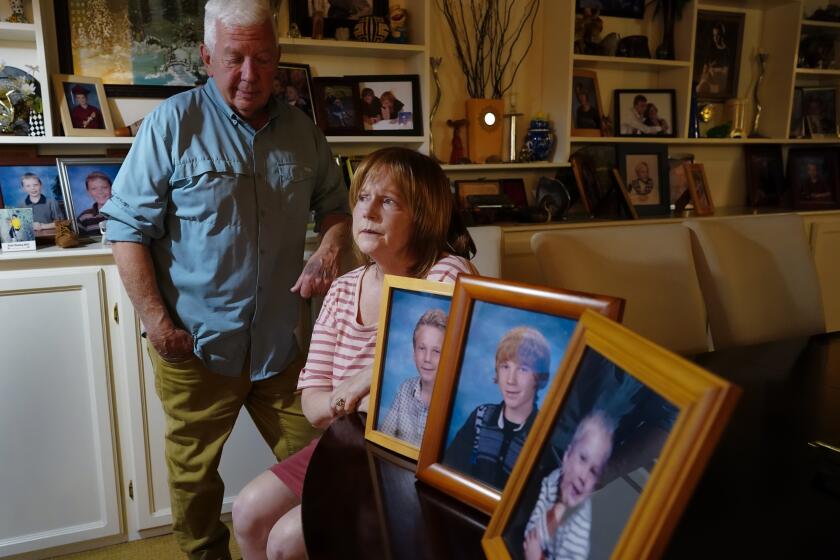
Cristina's mom, Cindy Hofer, applies lotion to Cristina's hands and arms to prepare them for bandages.
Jamie Scott Lytle
Order a copy of this photo
View A Slide Show
Visit our Photo Gallery
Cristina Perez' personal website -
www.ebpatient.com
Cristina Perez' Online EB store -
www.ebhealthandhome.com
SAN MARCOS -- On July 4, 1983, Cindi Hofer's life changed forever.
On that day, her daughter came into the world at 6 pounds, 11 ounces. But when Cristina came out of her mother's womb, she was missing skin from her right knee to her ankle and crying from the pain caused by the yellow blisters festering inside of her mouth.
An hour after she was taken from her mother's embrace, doctors gave the devastating diagnosis.
View A Slide Show
Related Story
Cristina had been born with recessive dystrophic Epidermolysis Bullosa.
Her skin was barely anchored to her body and was as fragile as the wings of a butterfly.
Both Cindi, and now ex-husband Abelardo Perez, carried the recessive gene that causes the incurable disease. Cristina, the doctors told them, had only two years to live -- tops.
"It was like a big slap of reality," Cindi said. "I had no idea what they were talking about. I just knew it wasn't good."
During the next 23 years, Cindi looked for "the cure." She has fought Social Security for medical benefits, given up her career as a real estate agent and abandoned personal relationships to tend to the needs of her daughter.
From the time she left the hospital, "baseball-sized blisters" continually flared up on Cristina's body and required all of Cindi's attention.
Cristina, she quickly learned, would have to be bandaged from her neck to her feet every day for the rest of her life to keep her free from infection.
The years were filled with stares and questions.
"What happened to her? Was she in an accident? Was she burned? Physically abused," Cindi said people would ask.
At one point, social workers knocked on Cindi's door after a woman at Toys 'R Us saw infant Cristina. They demanded to know why the baby had dried blood and wounds on her neck and ears, nose and arms.
Cindi had to explain EB, as she did to everyone who saw Cristina.
"It became a very lonely world," Cindi said.
Cindi's battle
It wasn't until Cindi and Cristina headed to the first national conference of the Dystrophic Epidermolysis Research Association, known as DEBRA, in 1984, that Cindi began to meet other parents and children living with the disease.
She flew to the conference to help parents across the world lobby for a cure and to meet doctors who knew how to treat the disease.
But she found only empty promises and unanswered questions, so they packed up and went home.
The following year, when Cristina turned 2, Cindi said she remembered that doctors had said the clock was ticking.
"I decided not to spend those years planning her funeral," she said. "Instead, I was going to spend the rest of her life trying to prove them all wrong."
When Abelardo and Cindi decided to end their seven-year marriage, Cindi said she knew she and Cristina would be alone from that point on.
"I became real desperate," Cindi said. "You get desperate when they tell you there is no cure for your child. I was willing to do anything for her."
So she booked a flight to Spain and took Cristina to live in the cottage house of a German doctor known to cure EB patients in Europe.
There were special diets that came from an organic garden and special natural ointments that carried a hefty price tag -- $30,000.
All of these treatments were going to heal Cristina, the doctor assured Cindi.
But by the end of their two months in Europe, some wounds had healed and Cristina had made progress, but blisters continued to flare.
There was nothing that would stop the disease.
Cindi said the trip to Europe drained her bank account, so mother and daughter packed their bags and headed back to live on a farm in Ramona.
Cindi began growing organic vegetables and raising chickens. She eventually quit her job in real estate to take on the role of Cristina's caretaker full time.
She began to learn, by trial and error, how to care for Cristina's oozing, broken skin, which sloughed off in layers.
Abelardo called to recommend a "blind miracle worker" in Mexico who prescribed herbs for all types of ailments.
Still, no results. Cristina's skin kept disappearing.
"As a parent, it really sucks the life out of you," Cindi said. "I came to a point where I realized there was nothing I could do. All I could do is make her have the best life possible."
Cindi decided to stop hunting for doctors and the best topical creams and start taking walks at the park with Cristina.
"I said, 'I have to live life now and take it for what it is,' " she said. "I had to take a different approach and make her life easier for her."
Cristina had beaten the odds and lived beyond medical expectations, so it was time to think ahead.
For the next decade, Cindi dedicated her life to fighting for Medi-Cal and financial support for Cristina.
Cindi said she did everything to find money for her supply of bandages and ointments, which she had to buy weekly.
"Over and over, they would say, 'we can't insure pre-existing conditions,' " Cindi recalls insurers telling her. "They said it's not that severe. It drove me nuts."
She wrote letters, screamed at doctors, and took Polaroid pictures of Cristina's wounds to show their severity.
To this day, she is waiting for the government to give her a full-time nurse to care for her daughter.
It was "impossible" to find someone who could handle her schedule: Monday, Wednesday, Friday and Saturday to change Cristina's bandages, a procedure that can last anywhere from an hour to three hours; Wednesday and Saturday to help her shower, a task that takes up an entire day.
Mother and daughter settled in the low-income Copper Creek apartments in the San Elijo Hills area of San Marcos after Cristina eventually got a steady Social Security check and Medi-Cal benefits.
Cristina's monthly $836 check pays for a three-bedroom apartment for $367, and provides a way for Cindi to accomplish one of her biggest goals -- make Cristina as independent as possible.
"It's been an eye-opener," said Cindi, about living with a child with EB. "You start to realize how fragile we all are and you start to think how we will not be here forever."
For Cindi, it has been a journey full of pain and love. A journey, she said, that has built internal strength in both her and her daughter.
A journey with no regrets, only hope.
"If I could turn back the clock, I would still give everything up for her," she said.
Contact staff writer Brenda Duran at (760) 761-4408 or bduran@nctimes.com
Cristina Perez' personal website - www.ebpatient.com
Cristina Perez' Online EB store - www.ebhealthandhome.com