Losing Ground: North County's shoreline victim of natural process
By: DAVE DOWNEY - Staff Writer | ∞
NORTH COUNTY ---- If only Santa Catalina Island were bigger. The popular tourist destination off the shore of Orange County is 22 miles long and 8 miles across at its widest point. Even at its smallish size, its rocky bulk shelters beaches from Oceanside to Los Angeles from giant winter waves and helps them retain sand, according to a new study by scientists at UC San Diego's Scripps Institution of Oceanography.
Similarly, other Channel Islands get credit for the relatively wide and sandy beaches around Ventura and Santa Barbara.
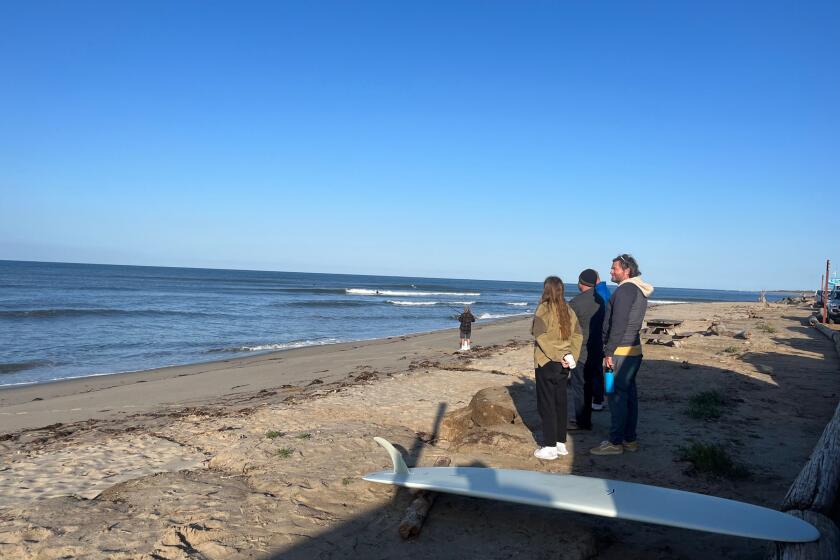
Farther south, much of North County lies outside of Santa Catalina's shadow. Its beaches bear the brunt of brutal winter swells. Consequently, local beaches tend not to be as sandy as those elsewhere in Southern California, said Bill O'Reilly, a senior development engineer at Scripps who spearheaded the study, in an interview last week.
O'Reilly recently presented study findings to the San Diego Association of Governments' shoreline preservation committee, which is contemplating another sand replenishment project like the one in 2001 that beefed up a dozen scrawny beaches from North County to Imperial Beach. The committee has decided to shop around for state and federal grants to defray the estimated $25 million cost of dredging sand from the ocean floor and spreading it on six miles of beaches.
After the presentation, Steve Aceti, executive director of the Encinitas-based California Coastal Coalition and a committee member, joked that the panel's priorities might be misplaced.
"All these years, we've been talking about trying to get a grant for more sand," Aceti quipped. "We ought to be talking about getting a grant to make Catalina Island bigger."
But it's not just the big waves.
The scientists found another set of villains in North County's picturesque lagoons ---- Buena Vista, Agua Hedionda, Batiquitos and San Elijo, O'Reilly said.
According to a brochure titled, "Littoral Cells, Sand Budgets and Beaches: Understanding California's Shoreline," which was published by the Institute of Marine Sciences at UC Santa Cruz in October, sand is in constant motion. During winter, storm swells erode beaches and suck sand underwater, creating sandbars just offshore. The bars act like sand reservoirs. When gentler waves take over in spring, they push sand back up on the shore.
Waves also create a current along the coast that pushes sand south a mile each year. That movement is often interrupted by human activities and structures, such as Oceanside Harbor, O'Reilly said.
"After Oceanside, really, sand is pretty free to travel down the coast," he said. "But places like North County continue to be sand starved."
That's where the lagoons enter the picture.
Scripps scientists believe that the southerly sand flow is blocked by huge sandbars built up just offshore of the lagoons.
"Sand is essentially stalling in this area and then getting chewed on by the big waves," O'Reilly said.
Scientists aren't sure where the sand goes.
"We think that it may be moving away from the beach, out into the ocean," O'Reilly said. "And there is no mechanism for bringing it back onto the beach farther down the coast because of the nature of the waves around the lagoon."
O'Reilly said the bulky presence of the sandbars diverts the storm waves around the blocks of sediment, and focuses them onto spots south of the lagoons. There, just below the lagoons, erosion hot spots are created and beaches become particularly narrow, he said.
Below hot spots and in between lagoons, beaches are more robust. But the disrupted southerly flow prevents them from reaching their potential widths, he said.
"It is a new hypothesis," O'Reilly said. "We don't really have the information yet to prove it or disprove it. That's the next step. But it is consistent with the data that we have collected to date. It could be that this has been going on for thousands of years."
The theory, which stems from observations taken over the last few years, came out of something called the "Southern California Beach Processes Study," a $1 million project funded by the U.S. Army Corps of Engineers and California Department of Boating and Waterways.
O'Reilly said the project team plans to test its hypothesis and conduct an in-depth, follow-up study focusing on a particular lagoon in 2008.
The preliminary findings help explain why half the sand placed on North County beaches through the association's $17 million replenishment project in 2001 has disappeared. But O'Reilly said the theory does not suggest that such projects are a lost cause.
"If anything, I think it reinforces the general philosophy that this is a sand-starved region, and that if you want to have sandy beaches, it's likely that you're going to have to place sand on them from time to time," he said. "Waiting for sand to come from Oceanside is going to be a long wait."
Contact staff writer Dave Downey at (760) 740-5442 or ddowney@nctimes.com.
More Stories
- Losing Ground: North County's shoreline victim of natural process
- Barely a century after discovery, Equator's glaciers are slipping away in warmer world
- NASA approves another spacewalk if needed to work on folding stubborn solar array
- Mid-Atlantic commercial spaceport launches rocket carrying 2 satellites, its first liftoff
Advertisement
Rob wrote on Dec 17, 2006 7:40 AM:It has always been my belief, that to a large extent, the diversion, blocking, cementing of natural rivers, is a contributing factor. Without these natural rivers, functioning as they should, sediment, rock, gravel, sand etc, worn down by time and pressure, are not available to be washed out to sea and transported, utltimately to be deposted along our coastline. If we look at Los Angeles, we see cement riverbeds, such as the Long Beach, LA, and San Gabr and others such as the Santa Ana in Orange county. If I'm not mistaken, the Del Dios has been dammed and does not flow to the sea as nature intended. Point being, once again, we have changed the natural structure of our planet and wonder when things don't operate as they should. That does not mean to say that there aren't additional issues that come into play as discussed in this article, but my points possibly go to a root cause.
Curtis wrote on Dec 17, 2006 5:30 PM:Don't we have better things to spend tax dollars on than putting sand on beaches. If it is so important to the economy then let the people who directly benefit pay for it.
Oceanside Chris wrote on Dec 18, 2006 6:28 AM:Curtis, it is important to the balance of nature in keeping the sand on the beaches.
Mark wrote on Dec 18, 2006 12:57 PM:I think that all should be left alone. God intended things to be a certain way for a reason. Whenever man gets in the middle of something and thinks he can do better than God, everything usually gets messed up...thrown out of balance if you will.
Mark wrote on Dec 18, 2006 12:58 PM:I think that all should be left alone. God intended things to be a certain way for a reason. Whenever man gets in the middle of something and thinks he can do better than God, everything usually gets messed up...thrown out of balance if you will.
Adam Q wrote on Dec 20, 2006 7:12 AM:Mark got it right, but not totally. The sand on our beaches comes from the rivers and migrates up and down the coast with the ocean current. Here in North San Diego, our san used to come primarily from the San Luis Rey River. About 25 years ago, the county signed off on two mining operations in the San Luis Rey river valley that actuall dropped the river bed about 3 feet. If you drive out highway 76, you can see where the footings of the old Bonsall Bridge are almost completely exposed and if you travel east of I-15 you can see where there are huge ponds in the river bed now that were caused by mining. That's part of the problem. The other part is that Oceanside Harbor prevents the sand from moving south. Again, if you look at the beaches on Camp Pendleton, you will see that they get progressiveley larger as you go south from the San Onofre Power Plant until you get to Del Mar Beach which is enormous. Here's the good news. Now that Oceanside is installing a proper bridge accross the west end of the San Luis Rey River, they should be able to open up the mouth of the river so that it is allowed to flow naturally, there by allowing what sand is available to exit onto the beaches (theoretically). Also, the big jetty at the north side of Oceaside Harbor is almost completely filled with sand, so soon, the natural sand flow will be able to get around the harbor. I'm no scientist, but I have been surfing on these beaches for 35 years and I have watched all of this stuff happen. Aloha.
First name only. Comments including last names, contact addresses, e-mail addresses or phone numbers will be deleted. Attempts to misrepresent your identity or impersonate any person will not be approved. All comments are screened before they appear online, so please keep them brief. Comments reflect the views of those commenting and not necessarily those of the North County Times or its staff writers. Click here to view additional comment policies.
Today's Stories
Advertisement