SDG&E: Consumer group plan 'crumbles under microscope'
By: DAVE DOWNEY - Staff Writer | ∞
San Diego County's electric utility went on the offensive Friday in defending its proposed power line, saying a consumer group's alternate plan for keeping the lights on is a collection of "Band-Aids and quick fixes" that won't significantly curb costs.
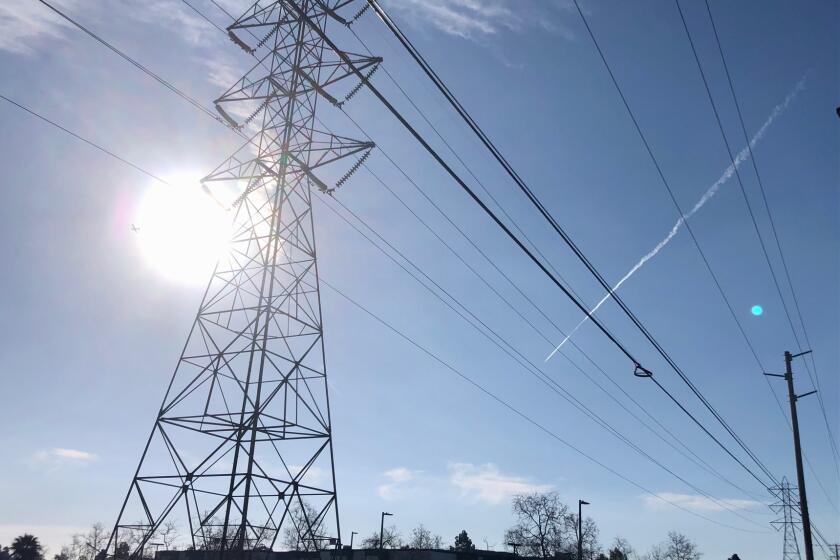
The comments came as state regulators are reviewing a plan for San Diego Gas & Electric Sunrise Powerlink, a 150-mile superhighway of electricity that would run from El Centro to San Diego. With wires strung from towers as tall as 150 feet, it would wind through Anza-Borrego Desert State Park, Ranchita, Santa Ysabel, Ramona, Rancho Penasquitos and Carmel Valley.
The project is supported by many in the business community, but it has drawn criticism from environmentalists and residents, as well as groups of local utility critics such as the Utility Consumers' Action Network.
But SDG&E officials said the criticism is flimsy.
"It really crumbles under the microscope," said Scott Crider, San Diego Gas & Electric Co.'s public affairs manager for the Sunrise Powerlink, a $1.3 billion, 500-kilovolt transmission line.
Crider made the comment late Friday in a telephone interview as the company prepared to file a report with the California Public Utilities Commission rebutting earlier testimony by the Utility Consumers' Action Network of San Diego. The utility had until midnight to respond to reports filed by the group, as well as to testimony by community and environmental groups.
The testimony from the various parties will help frame the debate on the Sunrise Powerlink that will take place in hearings throughout July in San Diego. The commission is expected to decide in January whether to grant San Diego Gas & Electric permission to build the line.
The California Independent System Operator, the agency that operates the state's electric grid, has concluded it is needed not only to boost San Diego County's power supply, but to move electricity around the state.
"Now that we've seen all the proposed alternatives, we are convinced more than ever that Sunrise Powerlink is the way to go," Crider said.
In its report two weeks ago, the consumer group proposed stringing more transmission lines along the coast where 230-kilovolt transmission lines run now, at the intersection systems belonging to San Diego Gas & Electric and Southern California Edison. Coupled with conservation efforts and new, small power plants that would fire up in summer, the expansion of that existing superhighway would be enough to meet the region's needs for another decade, the group said.
The option would deliver electricity at significantly lower cost to ratepayers, said Michael Shames, executive director of Utility Consumers' Action Network.
But the group ignored more than $100 million in upgrades that also would be required for 69-kilovolt distribution lines that move power from the coastal superhighway of electricity to communities, Crider said.
"When you add that cost into his (Shames') proposal, his economic benefits plummet," Crider said.
Crider chose a transportation analogy to underscore his point.
"It's like this: If you have a four-lane freeway and you expand it to five lanes, if you have a one-lane offramp, you also have to expand that offramp," he said.
Crider also said the consumer group's menu of options would deliver just enough power to satisfy the region's demand, and if any one component fell through, San Diego County would fall short of what it needs.
"That's what we refer to as just-in-time planning," he said. "We can't gamble with our customers' future like that."
In other testimony submitted Friday, the state Division of Ratepayer Advocates ---- the consumer arm of the Public Utilities Commission ---- disagreed with an environmental group's criticism of a solar power plant the utility is hoping to plug into.
San Diego Gas & Electric has built much of its case for the line on the notion it would move Imperial Valley solar power to the San Diego area, helping the region comply with a state mandate to use non-fossil-fuel sources for a fifth of its supply. Both the plant and line are supposed to be up and running by 2010.
In earlier testimony, the Center of Biological Diversity argued that the engine technology proposed for the Stirling Energy Systems plant is very costly and wouldn't be ready for commercial use until 2020. The division said the technology could be ready much earlier, and costs could be shaved as Stirling built many engines.
"In the early part of the last century, Henry Ford realized that the secret to dropping the cost of 'horseless carriages' was using mass production," the filing states. "His implementation of mass production... enabled him to drop the time required to assemble a Model T from 14 hours to 93 minutes per vehicle, and ushered in the age of the automobile. The secret to the commercialization of the Stirling dish generator is exactly the same ---- the development of mass production."
Contact staff writer Dave Downey at (760) 740-5442 or ddowney@nctimes.com.
More Stories
Advertisement
Jeff wrote on Jun 16, 2007 9:42 AM:Sempra/Sdg&E has done its best to dismantle and destroy local power producing plants with its conniving to control our energy supply. They can't be believed or trusted any more than the oil companies.
Big surprise? wrote on Jun 16, 2007 3:24 PM:What else would expect to hear from the glutinous utility? Something more reasonable than the proposal to tear up pristine land and put in ugly massive power poles? Ha. Not a chance. Is this really news anymore?
POWER FOR THE PEOPLE wrote on Jun 17, 2007 2:18 AM:The people want plenty of electric power now and more in the future. Especially on hot days and dark evenings. Maybe even more if they go for home charged electric powered cars. It is only common sense to have MORE power available than you need than NOT ENOUGH. Security demands multiple generating sources and multiple transmission lines. Someday natural disasters or terrorists will knock down some power lines. Building lots of wind generators makes sense, but they were nearly worhless during last summers heat wave, due to lack of the normal winds. Quick build peaker plants are useful for short time peak loads but produce a lot less electricity for the same amount of fuel. They put out a lot more carbon dioxide than new large efficient plants to make the same amount of electricity. True economy and common sense say build power plants AND transmission lines well and build now for the future needs. Plan it now, start building it now. When you see it built do not think the lines are ugly, think there are the wonderful electric lines that make my income, health care and quality of life possible.
Thinker wrote on Jun 20, 2007 11:19 AM:If each of us just found one or two ways to reduce our energy consumption on the few hottest days of summer, we could significantly reduce the need for new transmission lines and for new fossil fueled powerplants. Each of us has to ask themselves, have I replaced my energy hog air conditioner with one that meets Energy Star standards? Is there a more efficient way to cool my home or business, like adopting the new Ice thermal storage cooling systems? Are my other appliances as efficient as possible? Get off your butts and we won't need a new powerline.
- TEMECULA: Protesters line intersection (1735)
- ESCONDIDO: City's dreams of an 'upscale' downtown may be dying (1485)
- ESCONDIDO: 3 DUI arrests, 46 impounds at checkpoint (1119)
- TEMECULA: Parade, fireworks draw thousands on nation's birthday (815)
- REGION: Study says two-thirds of state beaches eroding (777)
Advertisement