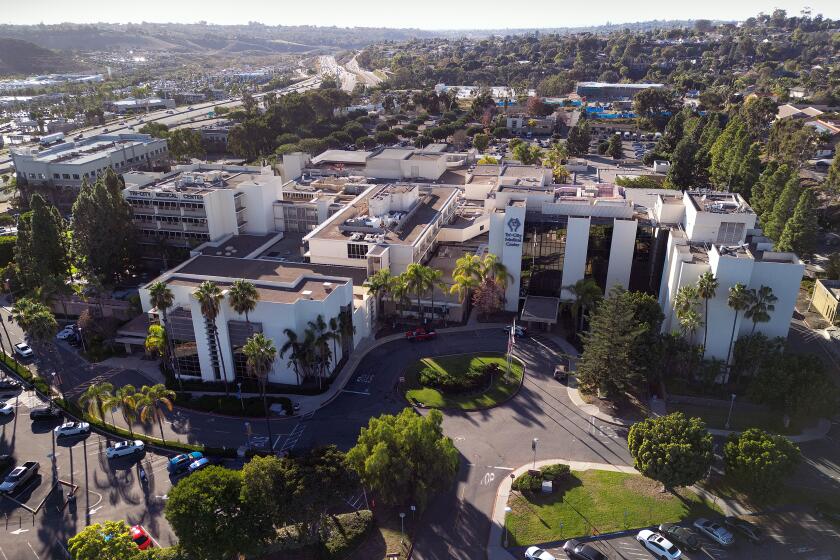
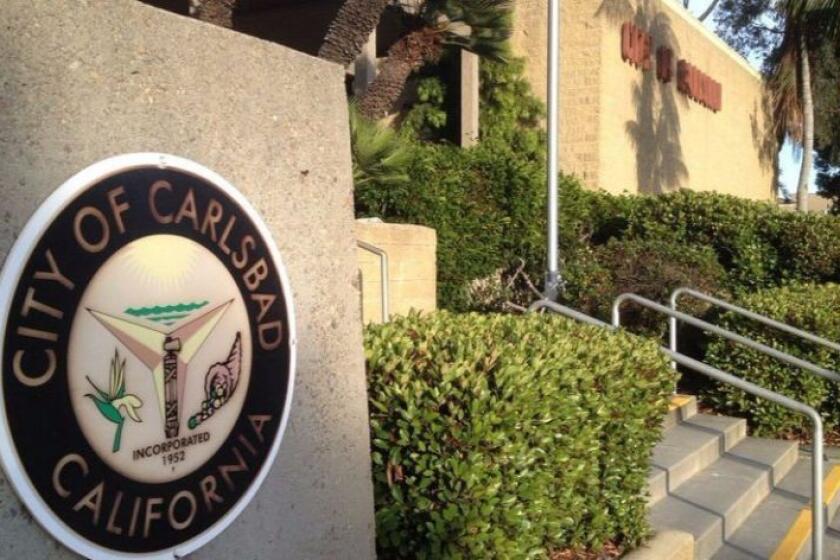
Construction continues on the new Encinitas library on Cornish Drive Friday morning, which overlooks City Hall.
Jamie Scott Lytle
Order a copy of this photo
Visit our Photo Gallery
By: ADAM KAYE - Staff Writer | ∞
Construction continues on the new Encinitas library on Cornish Drive Friday morning, which overlooks City Hall.
ENCINITAS ---- As the city's long-awaited library sprouts from a hilltop on Cornish Drive, one voice on City Council continues to question what role the $20 million building will play in an age where powerful computers can fit in a shirt pocket.
"I'm not in any way trying to denigrate the value of the library," Mayor James Bond said last week. "It will just be totally different. I think it will be more of an intellectual coffee shop than a library. Heaven knows it will have one of the best patio views in the city."
But one of Bond's colleagues says libraries ---- books and all ---- are here to stay, a prognostication shared by some academics and the county library director.
Bond says his misgivings stem from a career he spent witnessing technological advances as a telephone company executive. He retired more than a decade ago, but recalls when cell phones were as bulky as work boots and computers were the size of semi-tractor trailers.
Today, Bond said he responds to e-mails and updates his calendar on a hand-held computer from the comfort of his patio. Before long, he predicts, an equally portable computer will be able to store the entirety of a library's collection.
Bond voted last year to approve the library's construction, even though the project exceeded the city's estimate by $6.3 million.
"The information age is going to affect us all," he warned at the time. "We need our community and staff to come to grips with that."
'A brand new dinosaur'
As construction workers toil at the Encinitas library, officials in Escondido are debating how to pay for a new library after the state library bond failed last November. Escondido officials say whether a new library is built, or the existing one is remodeled, the facility should keep up with the times by providing plenty of computers.
On the coast, several new libraries have opened in recent years, and now, the computer labs are always filled with patrons.
In 1996, after $2.6 million in renovations, Del Mar opened a library in a former church. The Carlsbad City Library on Dove Lane, a $22 million project, opened in 1999. A $3.7 million library opened on a school campus in Solana Beach in 2001. The curvilinear Cardiff-by-the-Sea Library opened in 2003 at a cost of $2.6 million.
In Encinitas, Bond's colleague, Councilwoman Maggie Houlihan, a retired UCSD librarian, catalogued materials and taught people how to find them.
One of the biggest challenges libraries face, she said, is private interests attempting to privatize information.
"Jim's right," she said of the mayor. "I guess I could go online and pay $3 for that article, but why should I have to do that? Part of a democracy is to have free access to free materials."
Bond last week said he understands that questioning the relevance of the library rankles some constituents ---- he continues to refer to the library a "$20 million coffee shop" ---- but he stands by his notion that libraries are a dying breed.
"My only concern with the library is that it is kind of a brand new dinosaur," he said.
Challenging privilege
When completed, the 27,000-square-foot library will include community, teen and children's rooms, as well as space for the Friends of the Encinitas Library. A west-facing deck will command sweeping views of downtown Encinitas and the ocean.
Encinitas will own and maintain the building and the county of San Diego will operate it as one of 33 branch libraries.
Also planned is a computer lab with 40 terminals.
Like all of the public computers in the county library system, the ones in Encinitas will see heavy use from the moment the library opens, said Jose Aponte, county library director.
For many people, he said, libraries provide their only access to computers and the Internet.
And that's just one way that Aponte says libraries challenge the notion of privilege in a democratic society.
"First and fundamentally, 40 percent of citizens don't have access to online services," he said. "With the library card ---- that's the most valuable card in your wallet ---- you can get online for free."
Once connected, library patrons can gain access to more than $500,000 worth of databases. Articles and reports, which private parties must pay to read, are available free of charge at libraries ---- providing instant availability to a number of professional, medical, academic and business journals with just a few clicks.
Computers might be booked solid at libraries, but the copious information available online can be unwieldy, Aponte said.
"It's like the Library of Congress," he said, but "without card catalogues or shelves."
Bricks and mortar
By contrast, the 1.6 million items circulating within the county system are indexed and librarians knows just where to find them.
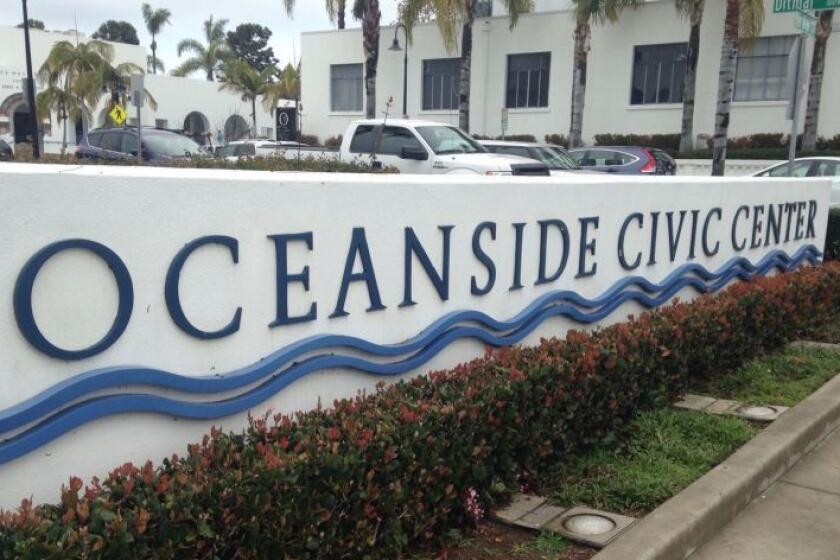
At Oceanside's municipal library last week, a MiraCosta College student said that with the help of a librarian, she dug up plenty of material for an essay.
After spending more than two hours at the library, which is designed to look like a California mission, Baptista Daniels, 23, photocopied some pages before heading home.
Nearby, men hunkered over newspapers and teens waited for their turns to use the library's computers.
"I personally like coming to the library," Daniels said. "It's a way to get out of the house."
Among other things, Aponte said, a home computer will never provide its user with the physical space ---- a temple of learning and knowledge ---- that libraries provide. An impoverished person sharing a small or crowded apartment won't find in a laptop the feeling of openness and solitude he finds in a library, nor will a computer screen serve as a kind of community fulcrum.
"Bricks and mortar," he said. "You can't get that through a Palm Pilot."
Cultural hubs
Libraries are more than just databases, said Christine Borgman, professor and presidential chair in information studies at UCLA. They are cultural and community hubs, she said, and since the days of Benjamin Franklin, they serve as "the people's university."
She added that despite technological advances, nearly 50,000 new book titles are published each year.
At any library, digital information can be especially difficult to preserve and curate, as new formats and storage media seem to evolve continually, she said.
On the Internet, free information represents but a fraction of the information that is available ---- for a price.
"What you're getting on the Internet is the small portion that is free, but you're sure not getting the journals that the city needs to be competitive," Borgman said.
Online content often is protected by copyright, which means looking at the material usually requires paying a fee ---- except at libraries.
"I think the role of the library as a provider of access to information, irrespective of economic capability or any other kind of restricting characteristic, will continue well, well into the future," said Brian Shottlaender, the Audrey Geisel librarian at UCSD and a member of the Library of Congress Working Group on Bibliographic Control.
Beyond unlocking the financial doors to reams of online information, libraries serve as repositories of local lore, where archival collections offer geneologies, oral histories and other information that most people won't find on hand-held computers.
Meanwhile, as the seemingly bottomless pit of content on the Internet continues to fill, it is inceasingly becoming more and more laborious to sort through it all.
"Ironically," Shottlaender said, "as more and more content is now available on the Internet, people are finding it more and more difficult to find stuff. The haystack is getting bigger."
Contact staff writer Adam Kaye at (760) 901-4074 or akaye@nctimes.com. Comment at nctimes.com.
Reader wrote on Jul 8, 2007 10:24 PM:Curling up in bed with a lap top just isn't as appealing as curling up with a book. Reading can be a leisure activity as well as a business/hand-held techno device. Books aren't dinosaurs, and not all information has been scanned into data bases. There is a great deal that is still only on paper. We need the library, Mr. Bond.
Jack wrote on Jul 8, 2007 10:58 PM:Computers dont yet have large numbers of books available to read on line and in most cases there is a fee imposed. This article is years ahead of being topical and even at such time there will be plenty of legitimate arguments about whether reading from a screen for a great length of time is healthy. It certainly isn't convenient. No, there is a long way to go before we have to consider this.
Question wrote on Jul 9, 2007 5:51 AM:Did I miss it in the news article?? Just when is this library slated to open?? And another question: Will coffee be available at the library??
retroboost wrote on Jul 9, 2007 6:09 AM:No matter how used the library is the taxpayers should be upset at how expensive this project was allowed to become and how we saddled our children with debt instead of ponying up ourselves.
Lisa wrote on Jul 9, 2007 6:17 AM:Typical Mayor Bond - votes to approve the library, then turns around and questions why we have one. It is time for you to go Mr. Bond.
Observer wrote on Jul 9, 2007 7:04 AM:Will the homeless, drug addicts and derelicts get their couches and coffee? Will there be a police on site?
mother wrote on Jul 9, 2007 7:11 AM:Whose the dinosaur in this story?
effinglibrarian wrote on Jul 9, 2007 7:18 AM:I love when people say that an entire library will fit in a palm-sized computer; they ignore the social component. If people can get everything online, then why are there several new companies renting books online? Not downloads, real books that you hold in your hand. Libraries are the cutting edge of technology, but mashed-up with the human element. It's a perfect synergy (like how I threw in several buzz words--gosh, I'm the coolest). Libraries never ignore people.
What? wrote on Jul 9, 2007 8:27 AM:I don't think it is too soon to be thinking about this and working on keeping libraries relevant. There are a number of reasons they are still important. Fist off there are still a lot of people who aren't comfortable with computers. Second we still haven't come up with a way for authors to earn a living by publishing online. So paper books are still the main way to represent value for authors. I don't think libraries are going away but they do need to evolve and keep up with technology if they want to stay off the endangered species list.
Library fan wrote on Jul 9, 2007 8:33 AM:the Childrens section alone is reason enough to save libraries. Little ones go to story times, get picture books, then finally move on to "chapter books". It's a learning experience for children that cannot be replicated. Cultivate readers dear Encinitas, not limited, short-sighted mayors who probably don't take time to read books.
Matt wrote on Jul 9, 2007 8:59 AM:Since when do I read books online?
Visit the Library Mr. Bond wrote on Jul 9, 2007 10:04 AM:I suggest that Mr. Bond go to the Dove branch of the Carlsbad library if he's conerned about usage and relevance of the new Encinitas Library. Yes, the information formats are evolving, but the demand and usage are very much there. Libraries are also gathering places for folks, and in some towns, are the "heart" of the town, especially when meeting rooms are available for presentations. I look forward to the new library in Encinitas; hopefully I won't have to drive to Carlsbad as much when it opens!
The Sculpin wrote on Jul 9, 2007 10:15 AM:A library will never lose data over a power failure, their battery will never blow up, and their hard drive will never crash. A library will never experience the blue screen of death. A library can operate without electricity. It's that simple.
What? wrote on Jul 9, 2007 11:24 AM:The Sculpin's arguments are pretty weak. A power failure will not cause data loss. The battery blowups were on laptops. Desktops only have half volt batteries to maintain the BIOs. Hard drive failures are rare and if you follow backup procedures they aren't that big of a deal. Finally a library may be able to opperate without electricity but I would bet they close in case of power failure. One last nail in the coffin of the fear of power failure. When was the last time there was a power failure that lasted more then a day? I think Sculpin is one of those people I mentioned in my first post who aren't comfortable with computers. That's ok but you really need to understand something befor you can effectively attack it. Here is a major advantage computers give to libraries. If a book is checked out you are out of luck until it is returned but a computer file can be viewed by as many people as you have computers. Want to take it home? Just print it. New technology isn't the enemy. It is just a tool. Parting shot, data loss is almost always user error. Save and save often.
Allen wrote on Jul 9, 2007 11:59 AM:Twenty years ago I published a column in which I suggested that in the era of computers, libraries would have to change -- and the most likely change would be to become "clubs" or mini-community centers where a small group of people used public money for a personal lifestyle. As I quickly learned, if you are ever lonely, write a column in which you say ANYTHING negative about libraries and the Friends of the Library and Mothers of America United will rise in righteous wrath and fill your mail box and answering device! Like the small family farm, libraries may be as useless as a buggy-whip factory, but the tiny social club of their membership will defend down to the last taxpayer dollar their right to have a tax paid culture club. In affluent communities, like Encinitas, Del Mar, La Jolla, and Rancho Bernardo, every resident can well afford to buy their own books and magazines. I cannot see taxing a waitressing single-mom to pay for my subscriptions, or a comfortable chair in a quiet, air-conditioned corner where I can relax at my neighbors expense. A “$20 million coffee shop” is an apt description.
to Observer wrote on Jul 9, 2007 12:19 PM:What are you observing? What derelict on a couch drinking coffee at a library? Libraries welcome all, not just diamond studded 'observers' like you. why not join the literary group and teach a homeless person to read so s/he can become productive and more self-confident? Coffee? Will you want caviar with that? Please, be real. A library offers not just books or computers, but the daily papers, family movies, lectures, presentations, audio tapes (blind people want to 'read' too) and so much more. When was the last time you rose from the comfy couch to allow a senior or cane wielding derelict to have a seat? For shame.
Bookworm wrote on Jul 9, 2007 12:26 PM:I work in the IT industry, so I fully support the advances of technology. Technology makes many things accessible to people within moments. However, there is another angle to this. People learn and absorb information in different ways - some are auditory, tactile, etc. When I have a lot of information to read on a topic, I prefer to read it in a book. When I want an instant answer as to who sang Tainted Love (Soft Cell by the way..) technology saves the day. There is a place for both types of tools, and they both have advantages and drawbacks. I absolutely think libraries are still relevant, and they absolutely need to keep evolving, but please don't get rid of the physical books!
Bond is a dinosaur wrote on Jul 9, 2007 12:26 PM:Libraries are here to stay- books are here to stay. It's up to the library to meet the needs of its clients as well as the city council voting in the required funds for updating and responsiveness. Get with it Bond. Didn't you go to the library as a kid? This is a free service that our communities need and deserve!
Bookworm wrote on Jul 9, 2007 2:57 PM:All the libraries I have been to recently (Carlsbad and Oceanside) are always busy with visitors. Sometimes you can't find an available seat. Interest in library resources has only grown over the years - I've been going to the library since I was in junior high. I can remember when it was easy to find a seat. I guess the public loves dinosaurs.....
Allen wrote on Jul 9, 2007 4:10 PM:Bookworm is part of the public-funded "club." Apparently, she is a long-time member. A tax-funded cultural leech, but a proud member of "The Club." Perhaps she and other members of the "tax-payer cultural club" could wear masks as their "gang colors." I would not argue with a public library in Imperial Beach, and probably not Oceanside, but Carlsbad? Encinitas? Del Mar? There are not 12 people in any of those communities who can't afford their own books, and there seems to be a Borders, Crown, Barnes & Noble, etc. on every corner. (Doing quite well thank you!). Ben Franklin's library was not tax supported...it was subscription-based, as was his first fire department, so please do not invoke his name in defense of public libraries. Libraries are simply a part of a civic edifice-complex, usually done on behalf of a small but influential "special interest group." Politicians just can't say "no" to Grannies pleading for books for toddlers! EVERY public school in San Diego County has a publicly funded library -- and when I last looked the County had about 70 city-based libraries. That is a total of 600+ taxpayer-based libraries in this county. You can't throw a rock that it doesn't break a library window. If you want your child to have a well-paying, easy, comfortable, non-stress profession, have them be a Librarian!
The Sculpin wrote on Jul 9, 2007 4:46 PM:I guess my comments were not clear. I am a full supporter of technology. I depend on the computer, the sat phone, the crackberry, wireless, ipod, and all that stuff. I am very comfortable with technology. I also fully support the existence of libraries as a vital link between history, culture, and technology. My point is that you don't necessarily need technology to have a library. I also feel that technology is not an end to itself, only a means to assist in human endeavors. The existence of technology does not replace a library. Creating a database on some computer and naming it "library" doesn't cut it. As for the 20M price tag, that's fair game for debate. What is not up for debate is the responsibility of government, acting as the representative of the people, to furnish said people with a complete and functioning library. If I were to take a cheap shot, I could say that "What" is so married to technology that he/she is blind to its limitations...or I would question Allen's education since he believes that a Borders or Barnes and Noble is the same as a library.....but I won't.
Allen wrote on Jul 9, 2007 5:37 PM:Sculpin: My "education" may be under question, but my schooling is at least decent. I am a graduate of the US Naval Academy at Annapolis. I have a Masters Degree in Management, an almost complete second Masters in Education, and spent 14 years as a University Core Adjunct Prof. of Computer Science -- 6,000 classroom teaching hours. More than 2,000 newspaper columns published; several in this newspaper this year. Not great "education" perhaps by your standards, but at least a damn good average.
Matt wrote on Jul 9, 2007 6:02 PM:Allen: If the residents of these communities are so wealthy to fork over $12-25 every week (some of us read a book every week or two), then why are you arguing that they shouldn't tax single parent waitresses? Can't she afford it? She must.
What? wrote on Jul 9, 2007 6:03 PM:What limitations of tech? I mentioned the only one I could think of, copyright issues and payment for said copyrights. You also don't need books to have a library, you could keep the information on stone tablets but books are so much better than stone tablets and computers are better still. Creating a database called library and putting on a computer wouldn't cut it. Put that database on a network, can you say world wide web? would be a great thing. Basically I think we agree that libraries are a good thing. I just think I am a little more pro tech than A Sculpin. The thing computers are best at is the storage and disemination of information which is what libraries are all about. They are made for each other. As for your taking cheapshots well that's ok. I would counter your cheapshot by saying I read the paper paper everyday. I am also a member of the National Geographic Society and read that every month. I don't own a cell phone, blackberry, wii, xbox or an ipod so you could hardly call me married to tech, we're just dating. Sat phone? Only the military and reporters in the third world use those which makes me question the sincerity of your claim to technophillia. Allen, there are poor people in every town. Yes even Carlsbad and Encinitas have slums.
KB wrote on Jul 9, 2007 7:43 PM:Allen, be realistic back in Franklin’s day taxes were used just to keep this country alive you’re comparing apples to oranges. I had more to say but I agree with a lot of what What? had to say so I’d just be repeating.
Allen wrote on Jul 9, 2007 7:53 PM:To What: Go to any meeting of the Friends of the Library and see how many "slum" residents are members. It is not the "poor" who frequent libraries. It is dowagers with a need for social activity; a quiet air-conditioned Gentleman's Club with nice chairs and recent magazines; and it is a free day-care for busy Moms whose school-age children have a school library that is not open late afternoons and evenings when Mom wants to shop -- all paid for by "someone else." (In urban areas, libraries are a haven for the homeless, but few homeless are seeking intellectual stimulation – just safety, warmth, cooling, quiet, and a bathroom. For those people, one book on the shelves is sufficient.) Research is much better on-line, but it is true that novels are easier to curl up with and it is that recreational reading that I contend should be purchased at a book store by those who can afford to do so. Research is spotty on the subject when last I looked, but something less than 15% of the population has ever set foot in a public, non-school based library. I understand the tactile need for people of my age to feel paper, but that is a lifestyle choice not a taxpayer need that must be satisfied. A larger population percentage of the same economic group frequents Starbucks. Perhaps that should be taxpayer-provided?
A-Librarian wrote on Jul 9, 2007 8:06 PM:I'm a librarian and I love my job (disclosure: I do NOT work for the city or county libraries), so I have to weigh in to say that I am busier than ever, and I feel more relevant to patrons than ever. Libraries and their staff are always adapting to changes in technology and our users' needs. It may be obvious to some, but our jobs are not easy, comfortable, nor stress-free: among other challenges of fulfilling taxpayers' needs, we are constantly having to defend our relevance to people who have not visited a library lately (physically or virtually). The Dove Library in Carlsbad is one area library I recommend anyone visit if you wonder what a public library is all about in today's world. It is hopping! All those people must be there for something good... And I don't know where Allen gets the idea that librarians are well-paid. I am sure a salary study of other professions requiring a Masters would prove otherwise.
Allen wrote on Jul 9, 2007 8:42 PM:To KB: I didn’t bring up Ben Franklin. In the article that name was broached by “Christine Borgman, professor and presidential chair in information studies at UCLA.” It is an interesting reference, however, because Ben was at the Constitutional Congress where the Constitution was formed. There is no mention of a Constitutional federal power of the national government to provide libraries, the State proposition to fund them was recently defeated by the people of California, and to the best of my knowledge, the City in question never put the library to a vote. Libraries are simply clubhouses masquerading as “Centers of Learning.” (They once were, but no longer). In this particular case, even providing taxpayer-supported PRIVATE rooms for a PRIVATE organization of sponsors (read “special interest group”), the Friends of the Encinitas Library.
Allen wrote on Jul 9, 2007 9:11 PM:To A-Librarian: Gosh, I don’t know how I ever got the impression that librarians are well-paid – but an article in Fortune magazine (march 14, 2004) says that “…a senior (San Diego City) librarian will haul in $765,000. But don't be confused: That isn't instead of an annual pension payout; it is on top of it.” As to stress, I Googled a list of stressful jobs from a 1999 Wall Street Journal Almanac, and “Librarian” was not on that list – however, it was number 10 on the accompanying list of LEAST stressful professions. (And I did not need to go to a library to find that information...) QED.
agitator wrote on Jul 9, 2007 10:13 PM:There's always one in the crowd to whine about "my taxes are paying for something I don't use." I don't have any kids. I don't like paying for public schools but I realize it's good for the entire society. People who post stuff like "only dowagers go to the library" are funny, and obviously have no idea what they are talking about. I have been in many libraries, and there are always an eclectic mix of people who use them. If you are one of those intellectually dishonest people calling himself a "libertarian" just say so. I know you would like to go back to the days of the robber barons or the old west, but it isn't going to happen. Get over it.
agitator wrote on Jul 10, 2007 12:18 AM:I give up. I can't take reading posts like Allens anymore. You "got the impression" that librarians are well paid by some Fortune magazine article mentioning some SD city "librarian" hauling in 765,000 dollars? Librarians average between 11 and 27 dollars an hour, from what I can gather. I'm not sure how useful these discussions are anyway, it seems they degenerate into references to personal "impressions" based on some cherry-picked information. Bye all!
Steve wrote on Jul 10, 2007 1:14 AM:Yes, put that money to make the Internet affordable for all!!!! The internet turned me into a reader, I can find lots of stuff to read by lifting one finger that would take 10 times longer in a library!!! Out with the old, in with the new!!! Some things die hard and the poor suffer for it.
Librarian wrote on Jul 10, 2007 7:56 AM:Allen, Your less than stellar research into librarian's salaries and work conditions is exactly why libraries are needed. Instead of evaluating and further researching the information you read in Fortune to see if it is accurate, you took it at face value. Your source is not scholarly or as reliable as other sources you could have found. As you have demonstrated, it is not enough to know how to surf the Internet. You need to be able to evaluate and use information to make sound, rational arguments not stereotypes based on one source. Libraries and librarians teach individuals like yourself how to access information, evaluate it critically, and use information effectively. If you did any further research you would have discovered that the median salary for librarians is $50,274. That is after obtaining a Master's degree. Visit http://www.ala.org/ala/ors/reports/salsursumart05.htm to view the full report. An additional source is the U.S. Department of Labor at http://www.bls.gov/oco/ocos068.htm which cites an even lower median salary. Please visit your nearest libray and open yourself up to the valuable information literacy skills that can be learned there.
Melanie wrote on Jul 10, 2007 9:13 AM:This whole discussion was started by an extremely short-sighted and ignorant leader. He apparently doesn't know that libraries are part of the foundation of democracy. Without freely available unbiased information, how can voters make sound decisions for their communities? Should they assume that they are getting the whole story from what comes on the news, what a small group of friends tell them, or a local newspaper chooses to print? Or does every household have the money to buy 5 newspapers and several periodicals to be informed enough to discern truth? The private club comments are also ignorant. I work in a public library and almost without exception, patrons range from middle income families to extremely disadvantaged persons who need the resources that others take for granted. Wealthy persons who are library advocates are usually sensible people who understand that without free information, the majority become misled and deceived, causing dangerous times for us all. If the libraries in question TRULY are not providing the type of material that I suggest above; they are not fulfilling the original purpose of public libraries. But I think the fact that the negative comments in this discussion come from those who don't use their public library probably means that this isn't the case and we should pity and excuse them for their ignorance.
karen ... wrote on Jul 10, 2007 9:52 AM:wow, what's next? burning books? how did they elect a mayor that can't/won't/doesn't read? how pathetic is that?
Serenity NOW!!! wrote on Jul 10, 2007 10:13 AM:I think James Bond is right about this. All these people -- mostly liberals, it seems to me -- get really sanctimonious about libraries. Libraries are like mom and apple pie, in that respect. Their utility can't be questioned in polite society. That said, on Friday night, there are way more people browsing and reading at private retailers like Borders and Barnes & Noble than at the local public library.
What? wrote on Jul 10, 2007 10:25 AM:Ok I am going to jump in one last time on this subject. I think libraries are a good thing. I think computer tech is an integral part of their future. As far as librarians being over paid or not I went after this info in my own way. I don't trust studies. People doing studies almost always have an agenda that will skew their data. So I went to the County of San Diego's website and then went to their job page. Hard data from a solid source. Librarian 1 $45K to $55K Masters or bachlors plus 9 semester units or 12 quarter units course work and 1 year experience. Librarian 3 $55K to $67K Masters and 3 years profesional experience or a Masters and 1 year experience as a level 2 Librarian. I can't really judge the stress levels because it is a very subjective thing. I will say that dealing with the public can be a real pain but it can also be very rewarding.
YankeeReader wrote on Jul 10, 2007 10:53 AM:Serenity wrote: "on Friday night, there are way more people browsing and reading at private retailers like Borders and Barnes & Noble than at the local public library." THAT is because the public library is closed on a Friday night - no funding in their tight budgets allocated for them to be open. Notice also that the retail patrons are browsing/reading, but are they actually BUYING to fill your investment portfolio?? So now, only LIBERALS read and support reading?? That makes complete sense, and I think "W" would agree with Serenity. Yahoo!
Serenity NOW responds!!! wrote on Jul 10, 2007 11:05 AM:To YankeeReader, thank you for proving my point.
Second Librarian wrote on Jul 10, 2007 12:58 PM:I got a laugh out of Allen's line: 'members of the "tax-payer cultural club"' A third of my city's residents have current library cards, another third have expired cards. (we keep records for only four years unless their card caries a fine) About 10% are not familiar with American society and so think that library use costs money they don't have. Finally, according to ...literacysandiego... 20%of adults read at or below a 5th grade level. Most of whom are not flocking to our literacy program - although more would with tutors available. Figuring a little fuzzy math here, that would mean that the percentage of citizens who don't need or use the library and who never have and never will are about 5%, or one in twenty. It seems like the people who would agree with Allen are part of a more exclusive club than those who love libraries. Congratulations!
Second librarian wrote on Jul 10, 2007 2:23 PM:I got a laugh out of Allen's line: 'members of the "tax-payer cultural club"' A third of my city's residents have current library cards, another third have expired cards. (we keep records for only four years unless their card caries a fine) About 10% are not familiar with American society and so think that library use costs money they don't have. Finally, according to ...literacysandiego... 20% of adults read at or below a 5th grade level. Most of whom are not flocking to our literacy program - although more would with tutors available. Figuring a little fuzzy math here, that would mean that the percentage of citizens who don't need or use the library and who never have and never will are about 5%, or one in twenty. It seems like the people who would agree with Allen are part of a more exclusive club than those who love libraries. Congratulations!
Reardon wrote on Jul 10, 2007 2:57 PM:Yes, Librarians make a relatively small but reasonable salary for the least stressful work available -- however they then can (in San Diego) retire at 75% of that salary PLUS a cash bonus of $750,000 plus. Their salary and benefits are great compensation for one of the World's least stressful jobs! Librarians do have Masters Degrees, but again in one of the least stressful and least competitive educational areas -- hardly the engineering or computer science level of required study. I don't denigrate Librarians -- they are uniformly nice people -- but the question at hand is the viability of a once absolutely necessary local educational tool into the 21st Century as a necessary educational tool. That is tenuous. Libraries are morphing into a recreational rather than an educational tool as more and more people use the Internet and computers costs are so low as to be disposable. That being the case, a Masters Degree in an educational field becomes less viable as well, Income is based on unique knowledge, great physical skill, or high danger or stress levels – none of which describes Librarians. Few people are paid well for being nice while working in pleasant surroundings. (Ask employees of candy stores, flower shops, book stores, and banks.)Yes, stress levels are subjective but most people understand that stress is real in professions where common phrases are “Down! Sniper on the ridge!,” “Get ready to jump!” “He’s got a gun!” “Out! Timbers falling!” “Fire in the hole!” “Dive! Dive! Aaaoooga” and not “Gosh! How did that book get placed on this row!”
validpoint wrote on Jul 10, 2007 3:20 PM:I work at a brand new library with over 100 computers available for public use. Let me say that the adults who need the free services in our area are not always the ones you want in the same building with those unattended or poorly attended children. Many of our regulars have criminal records, or are mentally ill or homeless. Any way to work a police substation or social services office into that new branch?
Local Librarian wrote on Jul 11, 2007 1:21 PM:The June/July 2007 issue of American Libraries has a short article on recently released national data on library use. The data "indicates that the number of visits to public libraries in the U.S. increased 61% between 1994 and 2004." "There were nearly two billion visits to U.S libraries in fiscal year 2004." "Overall circulation at public libraries in the U.S. rose by 28% during the decade, largely driven by significant growth in circulation of children's materials which grew by 44%. Attendance in library programs for children was also up 42% for this same period." The full report is available online [Web site] Based on this data, I believe libraries will continue to be of great value to their communities.
First name only. Comments including last names, contact addresses, e-mail addresses or phone numbers will be deleted. Attempts to misrepresent your identity or impersonate any person will not be approved. All comments are screened before they appear online, so please keep them brief. Comments reflect the views of those commenting and not necessarily those of the North County Times or its staff writers. Click here to view additional comment policies.
Today's Stories
Advertisement