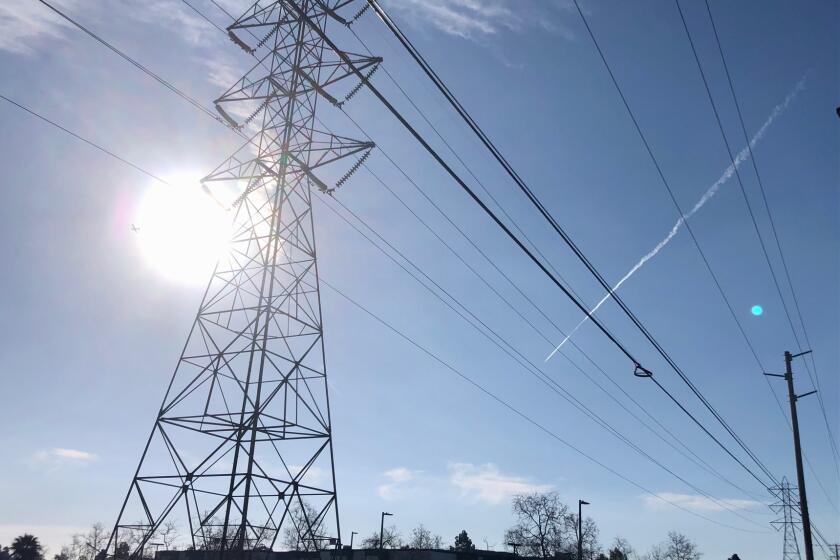
Panel: Sunrise Powerlink would clash with goals
By: DAVE DOWNEY - Staff Writer
Proposed transmission line called threat to balanced energy supply | ∞
An advisory panel representing a cross section of politicians, industry representatives and green energy advocates has concluded that building a power line would clash with San Diego County's long-term energy strategy.
The San Diego Association of Governments' Energy Working Group reached that finding in a symbolic 10-5 vote last week.
The panel decided that if a transmission line is built to bring in power through either Imperial or Riverside counties, it would interfere with a goal of boosting the locally produced proportion of the region's electricity supply to 75 percent by 2020.
San Diego Gas & Electric Co.'s proposed Sunrise Powerlink, a $1.3 billion, 150-mile, high-voltage line that would run from El Centro to Carmel Valley, was the focus of the committee's analysis. But the committee also evaluated another 500-kilovolt transmission line that would run 32 miles through the Cleveland National Forest of western Riverside County, from Lake Elsinore to Camp Pendleton Marine Corps Base.
The panel has no power over the fate of the Sunrise Powerlink, which would run through Ramona, Rancho Penasquitos and Anza-Borrego Desert State Park. And neither does the association's governing board.
The project's fate rests instead in the hands of a state regulatory body, the California Public Utilities Commission, which is to decide by August whether to grant permission to build the line.
However, SDG&E officials have been seeking the commission's endorsement since 2006, as the planning agency represents all 18 area cities and the county government and serves as a forum for debate on hot regional issues.
In late 2006, the board decided to hold off on taking a stand, choosing to wait until the utilities commission completed an extensive analysis of the project's environmental impacts. That report was finished in January.
The board also wanted to hear first from its Energy Working Group, which in addition to representing a cross section of influential politicians and industry people has some energy experts on it.
Voting with the majority were co-Chairman Henry Abarbanel, a Del Mar councilman and UC San Diego physics professor, La Mesa Mayor Art Madrid and San Diego Councilwoman Donna Frye. Others were representatives from the San Diego North Economic Development Council, Qualcomm, environmental groups and clean energy advocates.
Those opposing the panel's conclusion were San Marcos Councilwoman Rebecca Jones and representatives from SDG&E, the San Diego Regional Chamber of Commerce, Food and Beverage Association and San Diego-Imperial Counties Labor Council.
"There is just no way that you can make a finding that either transmission line is consistent with the full set of goals in the Regional Energy Strategy," said Bill Powers, a San Diego engineer and activist who has been speaking out against the Sunrise Powerlink, in a telephone interview.
Jones, the San Marcos councilwoman, disagreed. She said the Sunrise power line would accomplish some of the goals in the 2003-adopted Regional Energy Strategy, just not all of them.
And Jones suggested the goals the power line wouldn't address still could be accomplished by other means.
For its part, SDG&E maintained its power line never was intended to meet all the long-term goals.
"The Sunrise Powerlink is part of SDG&E's balanced energy plan for the region," said utility spokeswoman Jennifer Briscoe. "Sunrise is part of our energy future -- and it's an important piece."
On Friday, the association's Regional Planning Committee will consider whether to ratify the energy group's conclusion that the power line would not in fact deliver a balanced energy supply to the region. The planning committee is composed of some of the mayors, council members and county officials who sit on the board. The full board is expected to take up the matter March 28.
The energy committee debate revolved around the following goals:
Jones said the Sunrise Powerlink would improve the region's transmission capacity and help make its electricity more green. That, she said, makes the proposed 500-kilovolt line consistent with some of the 2003 goals.
"You can't just say that because it doesn't increase the in-county renewables that it is inconsistent," Jones said.
The problem, however, said Abarbanel, the Del Mar councilman, is that the project could interfere with the stated goal of producing half of the green energy locally.
"If a transmission project brings in renewables ... that's fine, that's a good thing," Abarbanel said. "And we understand that renewables generated elsewhere can't get here on trucks.
"But where's the incentive for, say, the city of Carlsbad to put solar power on its municipal roofs if all of the (green) energy is coming in from outside the region?"
Powers said the other problem is the Sunrise Powerlink's presence would trigger retirement of the 700-megawatt South Bay Power Plant in Chula Vista and serve as a disincentive for developing more local power sources of any kind. And by 2020, he said, the region likely would be importing more than half of its power.
Besides considering whether the power line is consistent with the regional strategy, the board is scheduled to determine next fall whether the strategy should be revised.
-- Contact staff writer Dave Downey at (760) 745-6611, Ext. 2623, or ddowney@nctimes.com.
More Stories
Advertisement
Howiek wrote on Mar 6, 2008 5:27 AM:They still haven’t told anyone who is going to be paying for all this solar—new taxes and fees? SANDAG has already stated it wants to increase taxes, but I think they have already spent that. Therefore, this totally UNELECTED body will simply ask for more money down the road!
We need renewables wrote on Mar 6, 2008 6:30 AM:How can anybody say that allowing a huge power transmission line IN will add to our goals. We need our own renewable green power. What we do NOT need is more power brought in from outside the county. It is a wonder that anyone can even think that. Of course, maybe it is profitable for some to have that viewpoint but it is dangerous for all of us to have to suffer the consequences. We need incentives to build solar and wind power generation IN San Diego. We should accept nothing less as citizens.
Burt wrote on Mar 6, 2008 7:34 AM:I see no point in giant spending for the inefficient transport of sunlight in the form of electricity from outside the county to inside the county. Look outdoors, the sun energy is already here, we just need to spend the money locally to capture it locally. San Diego has sun like other places have oil. Let's use it.
Peter wrote on Mar 6, 2008 8:41 AM:It is obvious that the goals of SDG&E are NOT the goals of citizens groups. The powerlink is not going to bring in solar energy. Where are these solar plants? The powerlink is going to bring in electricity from existent Mexican plants to circumvent State of California emissions requirements.
dane wrote on Mar 6, 2008 8:43 AM:This powerlink is just a 150 mile extension cord to feed LA's demands.
First name only. Comments including last names, contact addresses, e-mail addresses or phone numbers will be deleted. Attempts to misrepresent your identity or impersonate any person will not be approved. All comments are screened before they appear online, so please keep them brief. Comments reflect the views of those commenting and not necessarily those of the North County Times or its staff writers. Click here to view additional comment policies.
Today's Stories
Advertisement