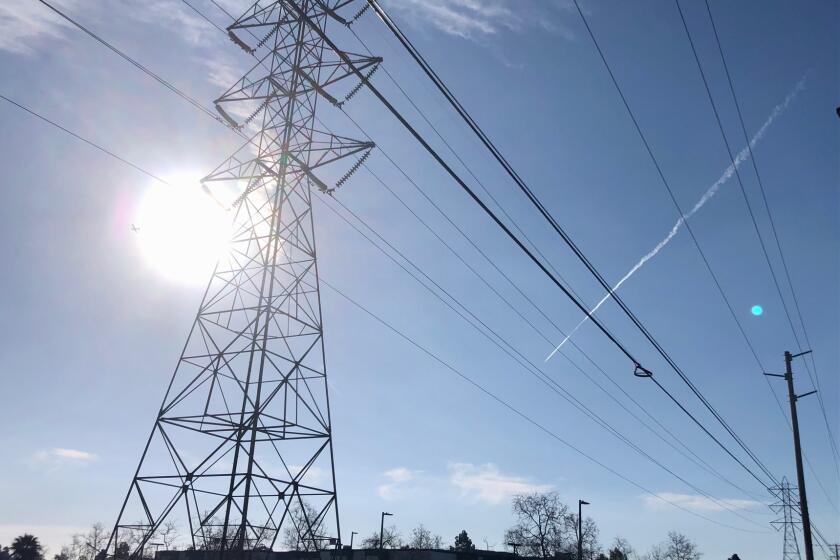
REGION: CPUC opens way for southern power line route

But one of two recommendations asks for project to be killed

By DAVE DOWNEY - Staff Writer | Friday, October 31, 2008 7:10 PM PDT

With the unveiling Friday of two potential outcomes for San Diego Gas & Electric Co.'s controversial power line, it is likely that the long-distance, high-voltage wires won't be strung through Ramona, Rancho Penasquitos or Anza-Borrego Desert State Park.

In a long-awaited recommendation for the $1.5 billion project, a judge for the California Public Utilities Commission urged that the line be rejected outright.

In a second, alternate recommendation, a commissioner suggested colleagues reject SDG&E's preferred 150-mile route through North County and Anza-Borrego Desert State Park, and instead authorize a shorter line through the southern part of the county. The 123-mile alternative would avoid the park and follow the Interstate 8 corridor to a substation outside Scripps Ranch.

Either of the two could form the basis for a decision by the five-member commission on the project's fate as early as Dec. 4, said Susan Carothers, a spokeswoman for the regulatory agency in San Francisco. Or, another commissioner could propose a different outcome, and the body could craft a decision around that.

SDG&E officials praised the alternate recommendation of Commissioner Dian Grueneich, reiterating their new support for the southern route.

"The alternate proposed decision issued today is a major milestone for the Sunrise Powerlink," said Michael Niggli, chief operating officer, in a statement.

"After three years of testimony, hearings, public meetings, a formal environmental review ---- and now both a proposed and alternate decision for the project ---- we are hopeful the full commission also will support the Sunrise Powerlink," Niggli said.

Project opponents also found much to cheer about.

"I am hopeful," said James Ward, who lives next to the park east of Julian and is director of Friends of Anza-Borrego State Park, an anti-power-line group that mass-produced opposition bumper stickers. "The CPUC is pretty clear about not having the line through the park. That makes me feel pretty good. But until this thing is dead and buried, I am not going to lift a glass of champagne."

Both the proposed and alternate decisions, which totaled more than 500 pages, found that wires strung from poles as tall as 150 feet would cause an unacceptable level of environmental damage to one of the nation's largest and most pristine state parks.

The proposed decision, penned by Administrative Law Judge Jean Vieth, concluded that the 1,000-megawatt power line is not be needed to shore up a shortage of power in San Diego County until at least 2014. Vieth also found that the project is not needed to convert 20 percent of the utility's electricity supply to green, renewable energy to comply with a state mandate.

And Vieth found that it would provide few benefits for an overwhelming cost.

But, in the alternate decision, Grueneich found that if the state's green energy requirement is raised to 33 percent ---- as the commission has proposed that another agency do as part of California's campaign to curb global warming ---- the line would be needed to meet that higher target.

Under a scenario where 33 percent of electricity is shifted from fossil fuels to green energy, the line would provide $100 million in benefits annually to utility ratepayers.

Grueneich proposed granting approval for a southern route on the condition that SDG&E agree to a "compliance plan" that would hold it accountable for putting green energy, and not natural-gas power, on the wires.

Michael Shames, executive director for the Utility Consumers' Action Network, a San Diego advocacy group that opposes the project, has been arguing the line is not needed for several years, or for meeting the existing green energy law.

"There's no question they pulled back the curtains and they saw that the wizard was just a balloon salesman," Shames said.

Shames also suggested that SDG&E would prefer neither recommendation.

"My guess is SDG&E is going to be shopping around for other commissioners to write additional alternatives," he said.

Not all opponents were happy.

Diane Conklin, a Ramona activist who has been supplying information about the fire threat posed by power lines to the commission, said the best solution would be to string no wires at all, but to build an array of solar and wind power projects in metropolitan San Diego.

"We hope the commission will realize that the southern route, as SDG&E agreed up until recently, is not a good choice," Conklin said. "The better choice is local, clean, renewable energy in San Diego for San Diego."

The commission recommendation is the latest in a series of missteps by and blows to the utility.

The company's initial environmental impact report for Sunrise was deemed insufficient, requiring SDG&E to redo the document by investing thousands of additional work hours and dollars.

The utility also has been blamed for its part in starting the deadly 2007 Witch Creek fire in Ramona, as well as the Rice fire, which swept through Fallbrook around the same time. The two fires destroyed more than 1,300 homes and killed two people. At nearly 200,000 acres, the Witch Creek blaze was the fourth-largest wildfire in state history.

In response, SDG&E officials this fall proposed turning off power to as many as 45,000 backcountry homes and businesses whenever extreme fire conditions existed. That prompted an uproar from the people who would have been affected, leading the utility this week to announce it was shelving the idea for now but will ask state regulators to consider allowing the practice starting next year.

Contact staff writer Dave Downey at (760) 745-6611, Ext. 2623, or ddowney@nctimes.com.

Previous

Advertisement

Pre-Registration Comments[-]Go to Top

burt wrote on Oct 31, 2008 5:32 PM:Talk about pulling back the curtain...got a few author's notes it appears, but anyway, WooHoo! Way to go.
San Diego has Sun like other places have Oil. Let's get creative and figure out ways to use it: there is an amazing amount of solar radiated roof top in SoCal that is otherwise quite unused. My residence has been nearly 100% solar for the last two years, including all the hot water I need. Nobody is fooled by the "low" gas prices right now...its just normal election foolery to take your eye off the ball. Oil has no place to go but more expensive in every way you can consider, unless You happen to own the oil company. Let's find some ways to start going Solar!

Ha wrote on Oct 31, 2008 5:43 PM:Northern route or southern route, both will end at the 160MW feeder and will be used to transmit electricity from Sempras plant in Mexico. That it will carry solar and wind energy is a lie.
They didn't build the multi-billion dollar LNG terminal at Costa Azul for nothing.

Nuck wrote on Oct 31, 2008 10:40 PM:I say build nuke plants all around the Salton Sea. We will have all the generation capacity we need for a very long time. Look at France one of the most liberal minded countries on the planet. 80% of France's electric generation is nuke......clean as can be. The fuel cells can be re-cycled...again and again and again. Great idea!!!!

ken6000 wrote on Nov 1, 2008 1:54 AM:One more battle to save Anza-Borrego behind us, for now at least. As a resident of Pine Cove (Idyllwild), I am not a SD County resident, but I spend a lot of time in the SDCO backcountry and ABSP. I applaud the local communities, from Ramona to Julian and the park, for mounting this challenge and saving one of the last best places in Southern California from a gigantic intrusion.

Ha is Right On wrote on Nov 1, 2008 10:58 AM:HA is right on. If Sempra had any tranparency they'd openly admit the fact that they'll be using Mexico as a source of revenue.

At what point in time does the public demand alternative energy sources be used by Sempra and create a plan for our children and not one just for the moment.

Nuclear is Clean by Risky wrote on Nov 1, 2008 8:28 PM:To Nuck: In France people are willing to pay higher taxes than we are in the U.S. They also are willing to subject the nuclear power industry to very strict oversight and regulations--and the pay a lot for these protections against a nuclear disaster.

Is the U.S. willing to pay a large part of the budget for these stringent oversights? Can we enforce the very strict and expensive regulatory procedures to make sure nothing goes wrong? One slip up can spell widespread radioactive contamination to people, the environment and atmosphere (Remember Chernobyl?)

Registered Comments[-]Go to Top

Advertisement

Videos