REGION: People still driving less, despite bargain fuel prices

Thanksgiving weekend travel to decline for first time in six years

By DAVE DOWNEY - Staff Writer | Thursday, November 27, 2008 7:21 PM PST

Despite the nose-dive in fuel prices, cautious area residents are still driving less than they were at this time last year ---- and less than they did when prices peaked in early summer, local traffic counts show.

Traffic volume on Interstates 5 and 15, and Highway 78 was down 4 percent to 8 percent last week from the week before Thanksgiving 2007, according to a statewide database called the Freeway Performance Measurement System. The database is compiled by UC Berkeley researchers and the California Department of Transportation.

At the same time, the Automobile Club of Southern California expected the number of cars to hit the road across the region over the long holiday weekend to total 2 percent less than last year.

"There are more important things in life than gas prices, believe it or not," said Marie Montgomery, a spokeswoman for the motorist organization in Costa Mesa.

Marney Cox, chief economist for the San Diego Association of Governments, a regional transportation planning agency, suggested the deteriorating economy is what's driving people to curb car trips.

"People are feeling really uncomfortable," Cox said in a telephone interview earlier this week. "Home prices have fallen. Stock market values have fallen. They are worried about losing their jobs. And that has offset any rebound we might have seen because of the falling gasoline prices."

Some people are driving less because they have lost jobs and no longer have an office or construction site to drive to, Cox said.

Others have managed to hold onto their jobs, but are leaving the money they save on gas in the bank, in case they need it for emergencies. And they are taking fewer trips to the grocery store and mall.

"We are seeing all-time lows in consumer confidence," Cox said.

People also are finding other ways to get to work, he said. They are doubling up on rides and hopping aboard buses or trains.

Indeed, few of those who parked cars during the gas price spike last spring appear to be ditching public transit as costs continue to fall.

Sam Johnson of Murrieta, who drives to Escondido and takes an express bus from there to his job in downtown San Diego, said, "I noticed that, on my bus, it's a lot more crowded even with gas prices going down."

According to North County Transit District statistics, Coaster ridership in October was up 10 percent over the same month in 2007 ---- just as much as it was in June when fuel prices were twice what they are now.

Overall, for the year to date, rider totals for the district's system of public buses and Coaster and Sprinter trains is up 23 percent over 2007, agency spokesman Tom Kelleher said.

"There has been almost a sea change in people's attitudes toward public transit," Kelleher said.

But, he said, it is too early to gauge whether the shift is a permanent lifestyle change.

Still, the choice many have made to stay home this holiday weekend is a significant change.

Montgomery, of the Automobile Club, said this is the first Thanksgiving weekend in a half-dozen years in which car travel around Southern California isn't expected to increase over the previous year. The last such declines came in 2001 and 2002, after the Sept. 11 terrorist attacks chilled regional travel habits, she said.

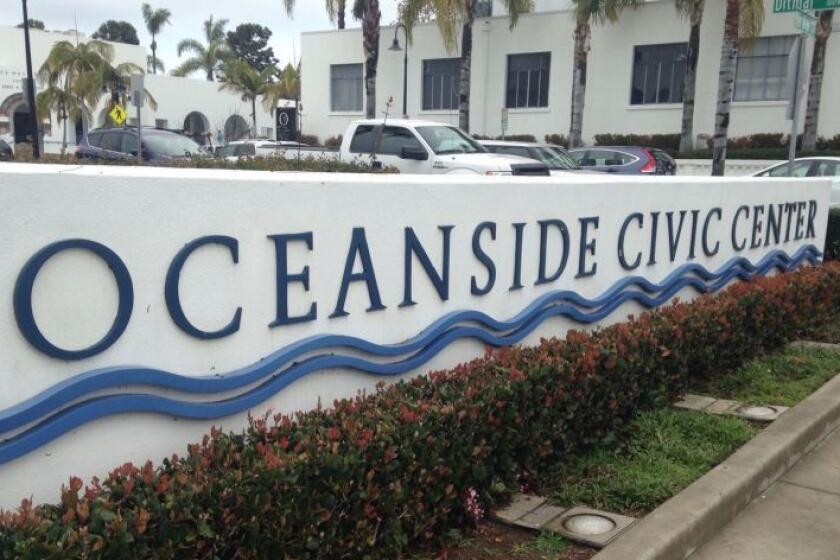
According to local freeway traffic counts, car travel last week declined 8 percent year over year on northbound I-5 at Highway 76 in Oceanside ---- and by more than 10 percent from mid-June, when gas prices were approaching $5.

Traffic counts also were down year over year the week before Thanksgiving by:

-- 7 percent on northbound I-5 at Tamarack Avenue in Carlsbad;

-- 5 percent on eastbound Highway 78 at Vista Village Drive in Vista;

-- 4 percent on westbound Highway 78 at Twin Oaks Valley Road in San Marcos;

-- 5 percent on southbound I-15 at Centre City Parkway in Escondido;

-- 4 percent on northbound I-15 at Poway Road and Rancho Penasquitos Boulevard.

Contact staff writer Dave Downey at (760) 745-6611, Ext. 2623, or ddowney@nctimes.com.

Next Previous
Bookmark and Share

Advertisement

Pre-Registration Comments[-]Go to Top

Civic leader wrote on Nov 27, 2008 10:44 PM:I'm afraid that the reduced traffic is only because the economy is so weak, and that people will go back to their humongous Ford Exhibitionists once their incomes go back up. Only time will tell.

Regardless, the U.S. should raise fuel tax to $1 a gallon to discourage gas hogs, and balance that out with lower income taxes for everyone. I drive about 10 miles a day in a Honda Civic, so there's no reason for my income taxes to pay for trillion-dollar expenses like 10-lane highways all over Southern California and U.S. military bases in oil sheikdoms.

Ralphie wrote on Nov 27, 2008 11:22 PM:All those couch potatoes can stay at home, better driving for me! Just recently had an Oregon road trip. Planning another multi-day road trip real soon. Tip: gas is even cheaper when you head East!

anotherview wrote on Nov 27, 2008 11:23 PM:The drop in road travel miles will have lasting positive effects. Roads used less will endure longer, costing less for repair and maintenance. Funds not spent on road upkeep can go to meet needs elsewhere in budgets, or to reduce budgets. Cars driven less will last longer and require fewer repairs, leaving more disposable income to households. Less air pollution will result from fewer miles traveled by cars, reducing health problems and their related costs. Drivers who use their cars less may walk a little more, gaining exercise which may contribute to overall health. Lower demand for gasoline from less use of cars will hold down the price of gasoline at the pump, leaving more household disposable income. The reduced demand for gasoline will cut back on American dependence on foreign oil by a quantifiable amount. The list goes on. As my dear mother used to say: Good comes with the bad. Let us see this crisis that way.

Walt wrote on Nov 28, 2008 6:54 AM:Here we go again with the percentage game! Even if the road use reduction is only 4% and transit increase 23%, transit, because of its near negligeable volume, is attracting only about 15% of the raod reduction. Actual numbers of travelers would put this in context.

Hummers and such wrote on Nov 28, 2008 7:40 AM:I'm actually sad that the gas prices went down. It doesn't matter to me if we are the cause of global warming or not, I think it's wrong to assume that we don't contribute to pollution by wasting so much gas. I think people that need to buy big trucks like Hummers or drive BMW's have low self esteem. I don't need a gas guzzler/luxury car to feel good about myself.

blm wrote on Nov 28, 2008 7:52 AM:I'm not changing my driving habits from where they were when gas was nearing $5/gallon just a couple of months ago. The oil companies shot themselves in the foot by getting greedy (like a certain baseball players strike I remember...), and now they'd like to buy a little forgetfulness. Well, a perception change occurred: SUVs got parked a lot more, Prius drivers look smart now, public transit turned out ok sometimes, and auto makers are starting to build electric vehicles to meet a real demand. It’s about time. Our economy can use a grand vision to build a new sustainable energy infrastructure, we won't miss the oil wars I'm sure, and we have a chance for cleaner air to boot. For the first time, I see some real change potential, but I know "they" can change the oil prices back up at any time once we're hooked again. I'm not taking the bait.

Corrected prices wrote on Nov 28, 2008 9:16 AM:They're maybe getting close to where they ought to be--but they never did fall as fast as the price per barrel(crude)did--hardly a discount.

Walt wrote on Nov 28, 2008 10:17 AM:For blm: Change indeed. Hybrids and more energy efficient cars are a start. But longer tern we need multipliers, not just a few percent improvement in both energy and land use. Automated very lightweight vehicles traveling on clean electrified guideways can cut energy by more than half and land use to a third for the same traffic volumes.They preserve the essential personal on demand rapid non-stop travel directly to real destinations automobiles now provide. National leadership is needed to give cities a basis for shifting to 21st Century technology instead of trying to get travelers out of cars into buses and trolleys they long ago rejected.

Derek wrote on Nov 28, 2008 9:40 PM:"National leadership is needed to give cities a basis for shifting to 21st Century technology instead of trying to get travelers out of cars into buses and trolleys they long ago rejected."

What are you talking about? The San Diego Trolley is quite popular. And the MTS premium express route 860 I took recently had a standing room only crowd.

blm wrote on Nov 28, 2008 9:58 PM:Having both a Physics degree and years of watching "science fiction" come to life, Walt, I include your concepts in my thoughts about a "grand vision for a sustainable energy economy". But we got started here by a kick in the economic pants (or some other nearby part of our anatomy), and I think the way to continue to make progress toward what you propose is to find the incremental steps that will move us closer to those goals a year from now, and even closer two years from now. I don't want to see people get complacent with the falling gas prices, and decide once again to leave the fossil fuel problem "for later". And as far as National Leadership goes, I think we've finally got one that thinks this way too. Bring on the next generation of fuel and travel!

George wrote on Nov 29, 2008 12:03 AM:Hi, Derek! Mass transit handles a small fraction of the total transportation demand. Just because the 860 express is standing room only on one run doesn't mean all of the buses are running that way. Back on January 29th, for example, Bus Rapid Transit routes 980 and 990 were discontinued because there weren't enough passengers to justify the service. (Details are in "Minimum fee coming for toll customers", NCT January 19, 2007). And while the Trolley's Blue Line is popular with those commuting between San Diego and the Mexican border, the Orange Line and Green Line are operating below expectations. Travellers have made it quite clear they prefer driving their own car and have voted for congestion relief by expanding the freeways. Now we're waiting on SANDAG to get going and deliver on their promises.

Carlo wrote on Nov 29, 2008 4:57 AM:What people are feeling is the need to plan and economize, something a lot of our local governments should practice. Saving by not using gasoline has became a habit. Planning trips and using less gas is the right thing to do in these bad times. Alas, it will wear off. As money frees up and that great feeling of getting out there amongst them in our car all alone and in charge of the world, except for a few minutes at a traffic light. Oops, watch out for that traffic light camera! The freedom one has when driving all alone in a car we find very hard to give up.

Walt wrote on Nov 29, 2008 7:47 AM:For blm; I agree. Automated Personal Transport is not an overnight solution. But its major elements have been demonstrated over a period of 30 years. The system at model scale. There are about 150 fully automatic transporters in operation around the world., airports, etc. A rudimentary system has been in operation in Morgantown WV for about 20 years. Similarly ground transportation for Heathrow airport is under construction. UAE is designing a whole automated transport city, Masdar. Sweden, Korea, Denmark, Poland(!) have active programs. There is little doubt of technical feasibilty although it would be foolhardy to skip a "debugging" prototype especially for the computer controlled direct routing of vehicles to exact destinations. Financially it is on the margin. Probably doubtful profit if all capital had to be amortized, but considerably cheaper than typical mass transit when its capital is uncharacteristically included. Meanwhile USA sits around spending $billions for more of the same tolleys and buses that have had negligible impact on needs overall. They do not, with few exceptions meet demand for personal on demand transport.USDOT has been moribund. Yes hopefully change is in the wind. There are also powerful more of the same lobbies. My oil price concern is different. Long term gas will get even more expensive. Cars are getting better, but the small well spun moves to mass transit will result in even more expenditures of unfruitful value.

Registered Comments[-]Go to Top

Advertisement

Videos