Dr. Timothy M. Concannon and Technician Kristen Hickey treating a 2-year-old Yellow Lab named Baja Jake with a rattle snake bite at California Veterinary Specialist in San Marcos Wednesday. <BR><small><B> Waldo Nilo </B></small> <BR><A HREF="http://www.nctimes.com/forms/photo_services/linkorder.php?des= Dr. Timothy M. Concannon and Technician Kristen Hickey treating a 2-year-old Yellow Lab named Baja Jake with a rattle snake bite at California Veterinary Specialist in San Marcos Wednesday. ` " target="new">Order a copy of this photo</A> <BR> <A HREF="http://www.nctimes.com/news/photogallery/" target="new">Visit our Photo Gallery</A><br> <hr width="250">
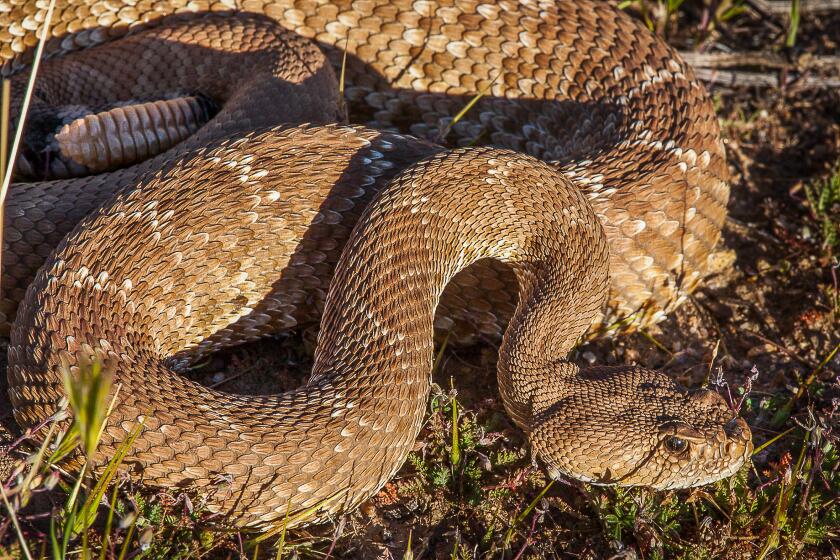
NORTH COUNTY -- It's rattlesnake season and as the weather gets hotter, people and pets will be at more risk of getting bitten.
Rattlesnakes began coming out of hibernation in March and will be active until the weather gets cooler in late October or even November, according to officials. Around North County on Wednesday, physicians and veterinarians said they are seeing an increase in animal and human patients coming into their offices with rattlesnake bites.
"I've had three (patients with) bites in four days," said Dr. Roy Johnson, a family practitioner in Valley Center. "It totally depends on the weather."
The frequency of incidents seems to be the same for pets.
"In the last week, the numbers have increased significantly," said Dr. Timothy M. Concannon, veterinarian at California Veterinary Specialists in San Marcos. "It's been a daily occurrence."
Reactions to rattlesnake bites are similar for pets and people. Though the bites are rarely fatal, symptoms include extreme pain or numbness, shock, blood-clotting problems, abnormal heart rhythms, tissue damage and swelling. Some victims can experience all of those symptoms because the venom has different purposes.
"It's like a package of a lot of different toxins," Concannon said, adding that the effects vary from the type of rattlesnake bite, to the snake's age and the time of year. He said it is believed that springtime can be the most dangerous period because rattlesnakes just coming out of hibernation have the most concentrated venom and baby rattlesnakes born in spring have poor control over their venom.
Johnson, who has training in herpetology, said that in western San Diego County there are three types of rattlesnakes: red, speckled and southern Pacific.
"The venom between the snakes is totally different," he said. "The most venomous is the southern Pacific and it's also the one that is most likely to bite."
Johnson said that if a person is bitten, they should take off any rings, watches or bracelets near the wound and go straight to the hospital.
"You do not cut, you do not suck, you do not apply ice," he said, adding that tying off the wound is also dangerous.
Both doctors say the earlier the bites are treated, the better the recovery will be.
On Wednesday, Baja-Jake, an 89-pound 2-year-old yellow Labrador retriever was recovering from a rattlesnake bite to the leg at the California Veterinary Specialists. He was bitten while in the back yard during the night on Friday and was brought in Sunday.
"I thought it was a bee sting," said Mira Mesa resident Lisa Brencick, Baja-Jake's owner. "When it got worse, I took him in but it was too late for the anti-venin."
She said Baja-Jake didn't have the usual symptoms.
"I didn't even think snake. It didn't even occur to me," she said. "It's a good lesson. We could have lost him."
Concannon said the percentage of pets that die from rattlesnake bites is low but it does happen.
"I would guess 10 percent," he said. "But people should seek attention (for their pets) as soon as possible even if they just suspect it's a snakebite."
Treatment is the same for pets and people. It can include pain relief, antibiotics, anti-venin injections and, in some cases, surgery on the wound and hyperbaric-oxygen treatment for faster healing.
According to Concannon, one vial of anti-venin is $400 and it could take up to five vials to work. A stay in the animal hospital can run from one to five days and from $700 to thousands of dollars. Early treatment for pets can save money because anti-venin lessens tissue damage, which is costly to correct.
Concannon recommends limiting a pet's ability to run freely outside between the months of March and November to prevent snakebites. Since timely attention is crucial, he also said it makes sense not to leave pets outside when no one is home.
"Curiosity is what gets them in trouble," said Concannon adding that 90 percent of dogs get bitten on the nose when sniffing a snake. Cats, he said, are usually bitten on the paw when they swat at a snake.
Some experts recommend that people avoid snakebites while in brushy areas by staying on hiking trails, wearing sturdy boots.
Johnson said that there is not much people can do to avoid snakebites except to be aware of their surroundings. If humans encounter a rattlesnake, they should just back off immediately. Standing still, he said, doesn't prevent bites.
"Most people get bitten because they pick it up," he said. "It's a behavior problem."
Contact staff writer Adrienne A. Aguirre at (760) 740-3526 or aaguirre@nctimes.com.
Posted in Local on Thursday, April 1, 2004 12:00 am Updated: 10:48 pm.
© Copyright 2009, North County Times - Californian, Escondido, CA | Terms of Service and Privacy Policy