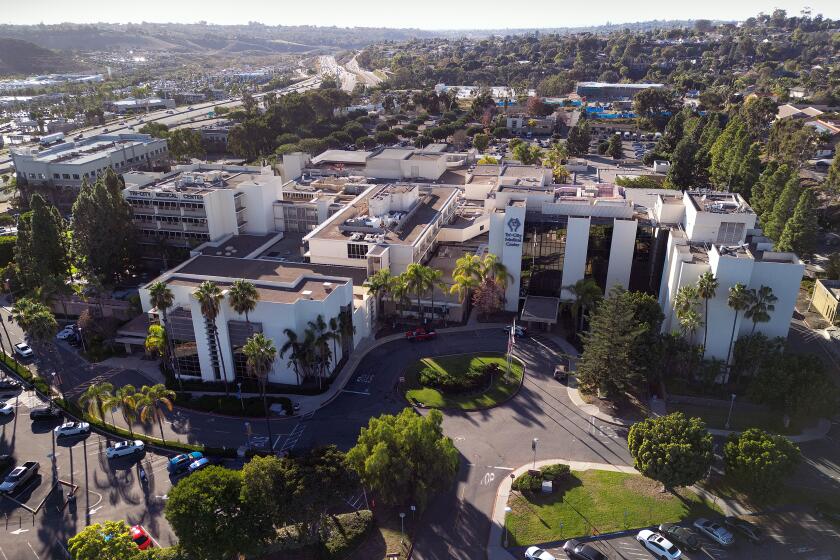
OCEANSIDE ---- Tri-City Medical Center is looking north to Orange County for a financial deal that could help the public hospital get out of the ruinous interest rates it is paying on about $57 million outstanding bonds.
In a special meeting Tuesday, hospital directors voted 5-0 to hire Orange County attorney Phillip B. Greer to broker an $80 million, one-year loan from the County of Orange at an as yet undisclosed interest rate.
Greer is also the personal attorney for Orange County Treasurer Tax-Collector Chriss Street, but Greer said Monday that that relationship would have no bearing on Tri-City's negotiations with the county.
Larry Anderson, Tri-City's CEO, said that a loan from Orange County could offer Tri-City much more favorable terms that are available from the commercial banking sector, which the public hospital has been trying to work with, to no avail, since January.
Anderson said state law restricts counties in how they can invest the tax money sitting in their coffers.
Generally, only conservative investments, such as certificates of deposit, are allowed.
But there is an exemption, Anderson said, for one government agency to loan cash to another.
Greg Moser, the hospital board's attorney, said he has worked several similar deals between government agencies in the past.
He said the financing method generally delivers an interest rate a half-percentage point greater than the rate the government agency is getting from its current investments.
"I just checked and they're currently getting about 1.5 percent," Moser said. "The worst deal the county could offer us is definitely better than the best deal that we could get from the commercial market."
Orange County has not yet provided loan terms to Tri-City, but Greer said details, including an interest rate, and what collateral Tri-City would have to provide, should be available by the hospital board's upcoming regular meeting on Thursday.
Anderson said Orange County recently did a similar deal with the Orange County Transit Authority, and Moser said he recently represented a hospital district in Marin County that borrowed money from the Marin County Treasurer for similar purposes.
Before voting with her colleagues to approve hiring Greer, hospital director Kathleen Sterling grilled the attorney about his clients, saying she feared a possible conflict of interest.
Greer said after the meeting that his representation of the hospital district and the treasurer, parties that both would be involved in any financing arrangement, was not a conflict of interest.
"I do not lobby Mr. Street," Greer said. "If he decides it's a viable deal, then it's a viable deal."
Sterling told Tri-City attorney Moser that she will hold him responsible for making sure that Greer brokers a clean deal.
According to the "engagement agreement" approved by the hospital board Monday, Greer will receive $50,000 to work with the hospital to broker a deal with Orange County.
If the deal goes through by Sept. 9, Greer will receive an additional $200,000 payment.
Tri-City finds itself looking for a new lender after a previous refinancing arrangement went sour.
In 2007, on the advice of the investment bank Citigroup, Tri-City refinanced its debt, using auction-rate securities to obtain an interest rate that was estimated at 3.5 percent.
Auction-rate securities break a long loan up into small pieces, selling them to investors in weekly or monthly chunks.
Because the terms are short, interest rates generally were much lower than they were for longer-term notes.
However, the market for auction-rate securities dried up in 2008 as national financial markets imploded under the weight of millions of subprime mortgages.
Suddenly, Tri-City found itself paying more than 13 percent per month, amounting to more than $400,000 extra per month.
Jeff Segall, Tri-City's vice president of public affairs, said Monday that the interest rate recently has dipped to 6 percent on news that the hospital is looking for refinancing.
He said, however, that the hospital's finance department expects rates to shoot past 10 percent as bidders see that the hospital has been unable to get the loan refinanced through commercial lenders.
In its previous attempts at getting a commercial loan to refinance the debt, which paid for various construction projects at the hospital in the 1990s, Tri-City was asked to put up about $50 million of its savings as collateral.
It was unclear whether that will be necessary with a deal from Orange County.
Segall said that the hospital plans to borrow an additional $23 million beyond the $57 million that it will take to refinance the auction rate bonds so that Tri-City will have enough working capital to accomplish various improvements to its facilities.
Deborah Schoch of the Center for California Healthcare Journalism contributed to this report.
Call staff writer Paul Sisson at 760-901-4087 or psisson@nctimes.com.