REGION: Residents continue to curb water use
After peaking in 2007, water use across Southwest County has dipped more than 20 percent, thanks to the economy, Mother Nature and a rate structure that penalizes homeowners when they consume large amounts of the liquid resource.
And residents continue to scale back their use, even though California's reservoirs are in better shape than they have been in years.
"Growth came to a screeching halt, and our water sales numbers reflect that," said Greg Morrison, spokesman for Elsinore Valley Municipal Water District, of the foreclosure crisis that started the downward trend.
Rancho California Water District spokeswoman Meggan Valencia said the back-to-back mild summers and wet winters have inspired customers to cut back more.
And Valencia said the debut of the "water budget" has made people think twice about letting sprinklers run for a long time.
"That's the thing that really catches people's eye," she said, in a telephone interview last week. "If you have to pay more, you're going to pay attention."
Downward trend
Rancho California Water District is Temecula's supplier. Its service territory takes in the entire city, plus Wine Country, De Luz and a sliver of Murrieta, an area that is home to about 120,000 people.
Total consumption in the district reached a peak of 87,639 acre-feet in the fiscal year that ended June 30, 2007, then fell 28.7 percent over the next three years to 62,477 acre-feet in fiscal year 2010 ---- the last year for which all area water providers have complete statistics.
Valencia said water use declined an additional 7 percent from fiscal 2010 to fiscal 2011, to 58,062 acre-feet.
An acre-foot is about 326,000 gallons, or roughly the amount two Southern California families use in a year.
A similar decline has occurred in the territory of Elsinore Valley, which serves 140,000 people in Lake Elsinore, Canyon Lake, Wildomar and a small section of northern Murrieta.
Morrison said Elsinore Valley consumption declined 23.2 percent between fiscal years 2007 and 2010, peaking at 31,878 acre-feet and dropping to 24,489 acre-feet.
A significant drop also occurred in the 542-square-mile territory of Eastern Municipal Water District, which provides water to 755,000 people spread from Murrieta to Moreno Valley.
Eastern spokesman Peter Odencrans said customers collectively curbed their use 21.1 percent during the same period, using a record 99,658 acre-feet in 2007 and 78,621 acre-feet in 2010.
Odencrans added that preliminary figures indicate consumption declined an additional 4 percent in fiscal 2011, which ran through last June.
"So it keeps dropping," Odencrans said recently. "Some of that I'm sure is due to the weather. Remember, we had a mild and rainy spring."
Water budgets
At the same time, officials from all three districts said the decline also reflects customers' changing watering habits. After going on water budgets, people are adjusting their lifestyles to be more efficient, they said.
And the tiered rate structures are something that Eastern, Elsinore Valley and Rancho California each have adopted in recent years.
Riverside-based Western Municipal Water District, which has 2,500 customers in northwestern Murrieta, is preparing to follow suit in October.
Under a water budget, each home is given its own allocation based on the number of people living there and the size of landscaped area outside.
That allocation moves up and down from season to season, based on temperature and rainfall, and adjusts if a cool month turns out to be warmer than normal, officials said. If a family stays within its allocation, it is billed at moderate rates. But if a family exceeds its district-imposed allocation, it pays sharply higher rates for the extra water used.
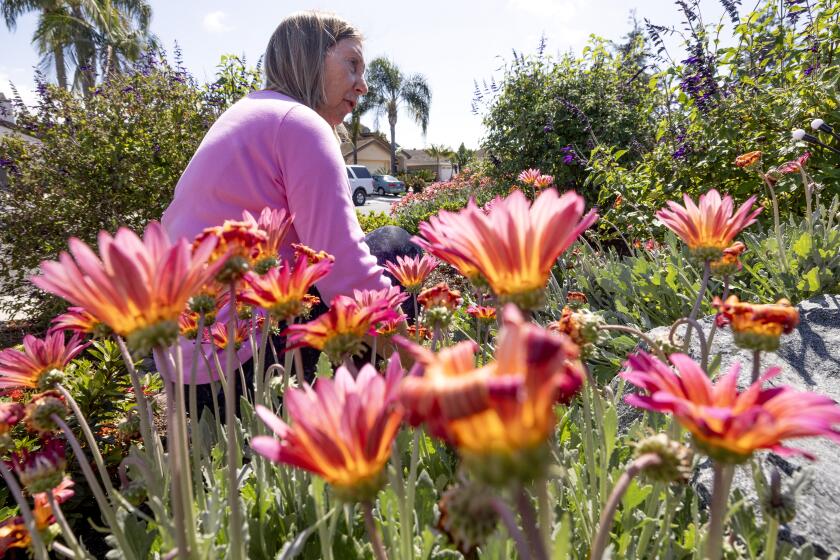
Jim and Christina Clinger of Temecula have managed to stay within their water budget since Rancho California went on the rate structure in July 2010. They have done so in part by shifting from twice-daily lawn watering to once each morning, and substantially scaling back the number of times they water their shrubs.
As a result, their bills remain in the $50-per-month range.
"I know it's hard for a lot of other people, especially the ones with pools," said Jim Clinger, while working in his yard on a hot day recently. "But we've been doing pretty good."
A benchmark
Clinger said he likes the idea of a water budget.
"I think it's great to have those kinds of restrictions, because we live in a desert and water is not abundant," he said. "I know that in places in Nevada, they're not allowed to have grass."
What the budget does is give a household a benchmark for determining the appropriate amount of water to put on a lawn, said Tim Barr, the water-use efficiency manager for Western Municipal Water District.
Barr said the billing system gets people's attention in the fall in particular. Water-budget allocations ratchet down gradually through October and November. But many families leave automatic-timer sprinklers set on the number and length of watering cycles used in mid-summer.
"They tend to keep that schedule all the way through until the rain comes," he said.
And yet, he said, as the days get cooler and shorter, plants do not require as much water.
Efficiency the goal
Barr said staying on a budget doesn't have to mean turning lawns into straw, or residents having to convert their yards into cactuses and rocks. And he said it hasn't happened in many Southwest County neighborhoods already on the water budget.
"As I drive through Temecula, I still see green lawns," Barr said. "But I see less water running down the street."
Barr maintained that the budget's debut this fall in the portion of Murrieta that his district serves won't create hardships.
"Sixty-eight percent of the customers don't have to do a thing," he said. "They are already under water budget."
And most others will find they don't need to turn on their sprinklers as much as they think, Barr said.
Western customers who believe they weren't given enough water will be able to request an adjustment.
Elsewhere, compliance with water budgets is running reasonably high in the districts that have them, officials said.
About 8 in 10 Eastern customers are hitting their targets, according to district statistics. And Valencia said about 9 in 10 Rancho California customers are hitting theirs.
Barr said the concept is changing how Riverside County residents think about water use, and creating a mindset of being efficient with every drop. It is a mindset he believes is here to stay, whether the region is in the grip of a drought, or like now, enjoying a period when there is plenty of water to go around.
In fact, Barr said, efficiency is what Western is stressing these days, as opposed to conservation.
"Conservation is a thing you do during a drought," he said. "Efficiency is something you do all the time."


Please Wait…